
“Great price. Highly recommend this company for any service or repair.”
Ceiling Water Damage Repair in Las Vegas & Henderson, NV
Ceiling water damage repair starts with one question: is it still wet? Keep everyone out from under any sag, stop the water if you can, and call us. We map how far the moisture reached, dry what can be saved, cut out what can't, and rebuild the drywall with texture that matches the rest of the room.
A stain on the ceiling is where the story ends. It started somewhere else, at a roof seam or a condensate pan in the attic or a supply line upstairs. If the leak still needs a roofer, an AC tech or a plumber, we'll say so plainly, and we can start drying while that repair gets scheduled. Call 888-453-3591. A person picks up, day or night.
24/7 Response
IICRC-Certified
Licensed & Insured
Insurance Support
Google Reviews
10 reviews with a five-star rating.
Real customer experiences from Quality 1st Restoration across water damage, mold, repairs, and restoration.
5.0 10 verified reviews
Write a review
“Quality First Restoration is fair and they cared about me. They helped me through the entire process...”
“I was referred to Quality Restorations from an insurance agent. I was impressed that they answered the call...”
“Literally life savers!! I had been dealing with some skin issues...”
“We had a drainage pipe burst inside the wall of our laundry room, and the leak went downstairs...”
“Quality First Restoration is fantastic! The crew did a wonderful job with water damage.”
“I had the opportunity to meet with Todd. He is knowledgeable and responsive. We made the right choice moving forward...”
“The team at Quality First Restorations did a great job taking care of a water leak above our bathroom...”
“Quality First Restoration did an amazing job from start to finish. Professional, responsive, and high-quality work.”
“So I've worked with Todd at Quality First Restorations previously on a rental I have. The tenants had a leak...”
How serious is the water damage on your ceiling?
Not every stain is an emergency. A small ring that stays the same size for weeks is a record of something that already happened. But a stain that grows, darkens at the edge, or feels cool and soft to the touch? That one is being fed right now.
- 01 A brown or yellow ring that keeps its size is probably old damage, but confirm it's dry before repainting
- 02 A stain that spreads or darkens after rain or after the AC runs: active leak
- 03 Paint bubbling, blistering, or peeling on the ceiling
- 04 A bulge or visible bow in the drywall panel
- 05 Hairline cracks that widen along a seam, or tape lines showing through
- 06 Dripping at a light fixture or vent. Water and wiring share that opening, so don't wait on this one
One sign matters more than the rest: sagging. Wet gypsum board loses its strength. A ceiling panel holding water is a weight problem directly over your head, so keep people and pets out from under a sagging section until it has been assessed. The gypsum industry's own damage standard puts it bluntly: board that is no longer structurally sound doesn't get dried. It gets replaced.
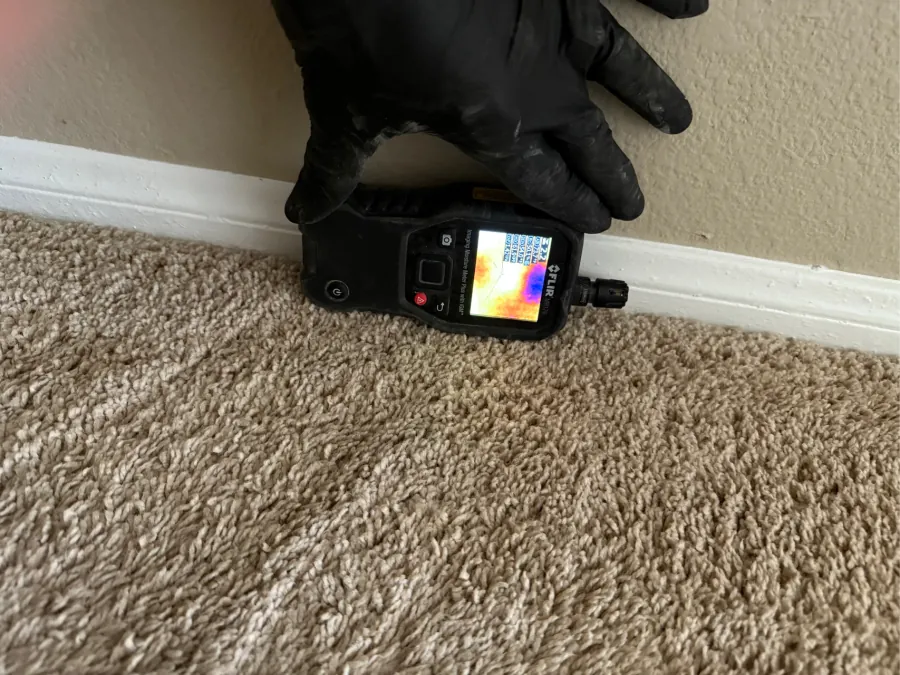
Before anything gets opened, we confirm where the water actually sits using thermal imaging and moisture readings, the same approach described on our thermal imaging water detection page.
How much does it cost? Will insurance pay?
Water mitigation in the Las Vegas Valley usually costs $1,500 to $4,800. That covers getting the water out, drying the structure and checking it with moisture meters until the readings are back to normal. If drywall, baseboards or flooring had to come out, the repairs are a separate estimate, so you see each part on its own.
For a ceiling, cost comes down to whether the board can stay up. A dry, stable stain may only need primer and paint once we confirm it's dry. A sag, soaked attic insulation or water from a toilet above means cutting out drywall. Then there's texture: matching a knockdown or popcorn finish can mean spraying more ceiling than the patch itself.
Water mitigation
$1,500–$4,800
Extraction, drying equipment and moisture checks.
Repairs
Priced separately
Only if drywall, baseboards or flooring had to come out.
Estimate
Free
On site, before any work starts.
Insurance or self-pay, you decide
Insurance usually pays when the water came on suddenly, like a supply line that split overnight. A leak that dripped for months usually isn't covered. Your carrier makes that call, not us.
We handle the record: photos, moisture readings and a line-item estimate built in Xactimate, the same software most adjusters use. Then you compare it with your deductible and decide whether to file.
Paying yourself? Ask about the self-pay discount. The estimate is free, and you see the price before we start.
Book a free estimatePlanning figures from our work in the Las Vegas Valley, not a quote for your property.
Can a water-damaged ceiling be fixed, or does it have to come down?
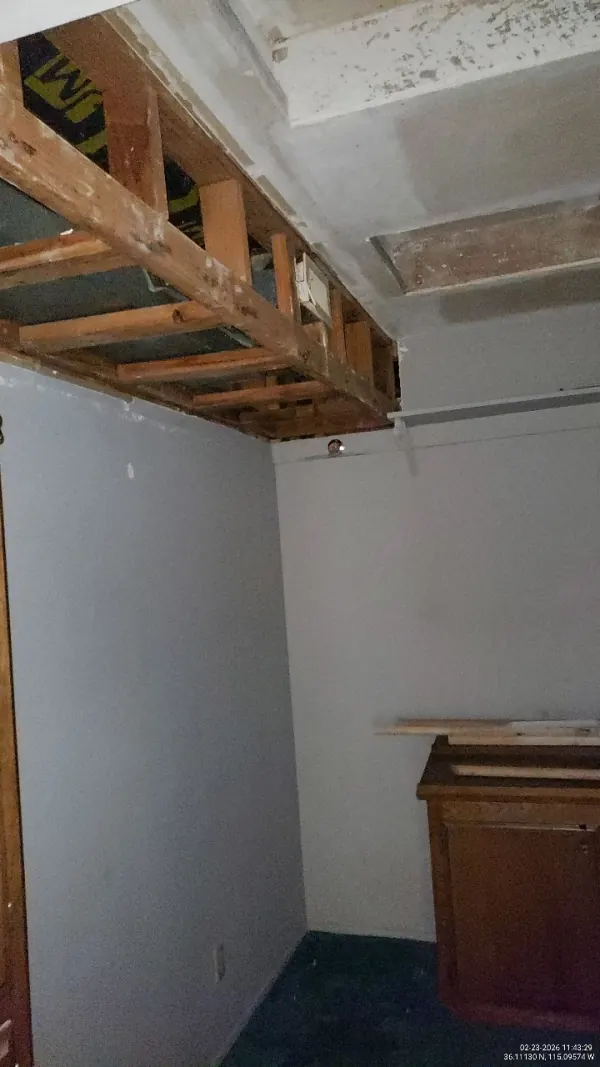
Start with the standard. The Gypsum Association's rules for assessing water-damaged board say wet drywall can stay only when all of these are true: the leak has been found and stopped, the water was clean, the board dried fully within about 24 to 48 hours, and the panel is still structurally sound. No soft spots. No delaminating paper. No rusting screws. Miss any one of those and the section comes out.
Where the water came from decides more than people expect. Water damage professionals group water into three categories: clean supply or condensate water, contaminated "gray" water, and grossly contaminated "black" water like sewage or storm runoff, per IICRC S500. An AC condensate leak starts clean, so fast drying can save the ceiling. Storm water that crossed a roof, or any sewage backup from above, is different. Board it touched gets replaced, no exceptions.
That threshold comes straight from the gypsum industry's water-damage assessment standard (GA-231) , whose own closing rule is blunt: when in doubt, replace it.
Here's a version of this that turns up a lot in two-story homes. The wax ring under an upstairs toilet fails, every flush leaks a little at the flange, and months later a stain shows up on the ceiling below. However clean that water looks, it's Category 3. The drywall it touched comes out. It doesn't get dried.
That decision (dry it or cut it) is where our structural drying and drywall repair and replacement work meet. You don't have to know which one you need. That's the assessment's job.
What we repair, and which trade fixes the leak itself
A ceiling repair has two halves. It helps to know who owns which.
We handle everything the water touched.
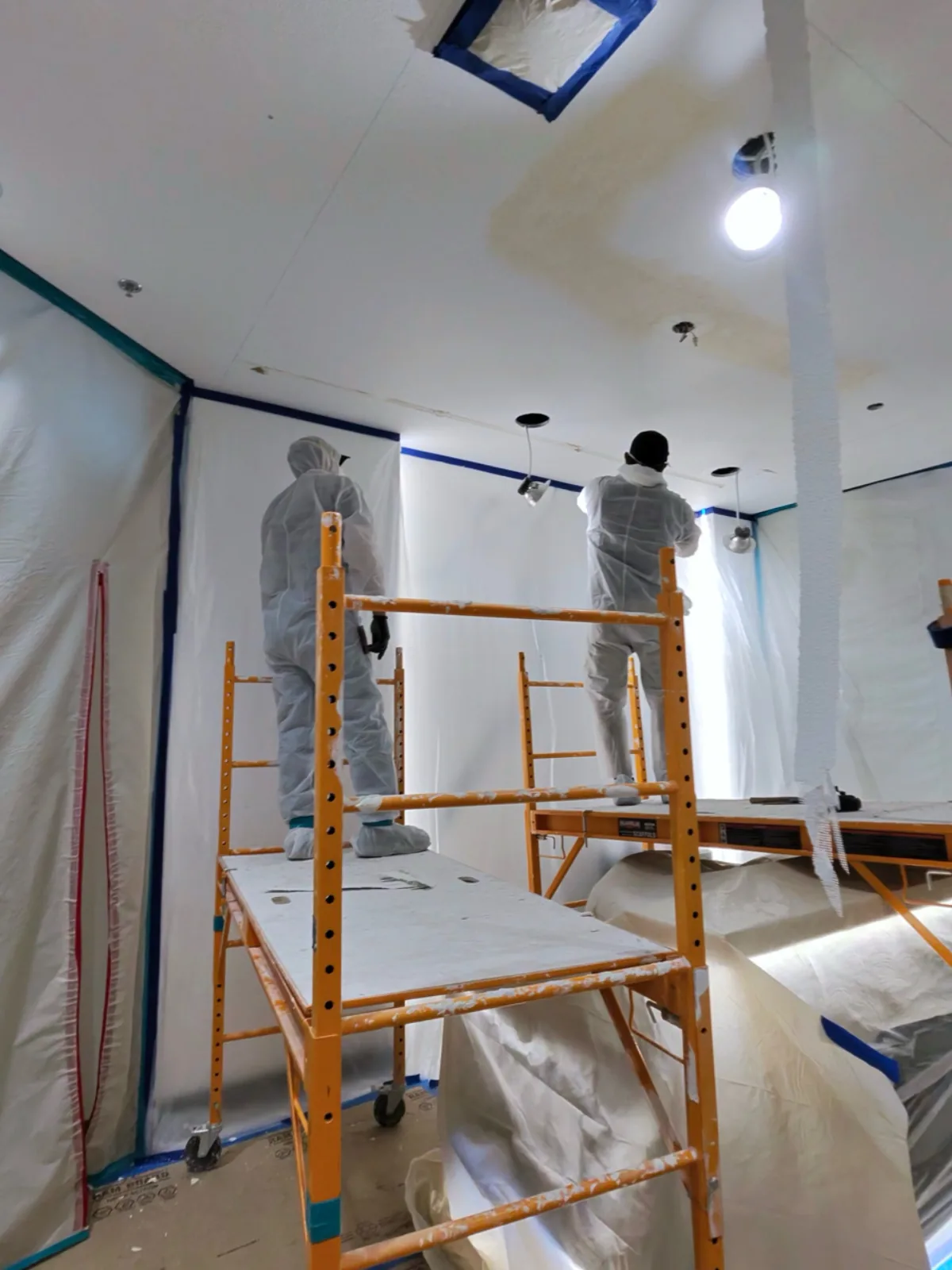
Moisture mapping across the ceiling and into the walls. Drying with monitored equipment. Controlled removal of drywall and wet insulation that can't be saved, and then the build-back: new board, tape, mud, texture matched to the existing finish, primed and painted.
A licensed trade fixes the source.
A roof leak belongs to a roofer, an overflowing condensate pan or clogged drain line to an HVAC tech, a weeping supply line or drain to a plumber. We don't do those repairs. And a ceiling rebuilt before the source is fixed is just the next stain waiting.
What we will do is tell you which problem you actually have. Water rarely drips straight down. It runs along framing and shows up somewhere else, which is why part of the first visit is tracing the path, so you call the right trade once, instead of guessing twice. If the source is a roof leak after a storm or an AC drain line, our roof leak water damage and AC leak damage cleanup pages follow each of those trails further.
Not sure whether you need a roofer, a plumber, or us? Call 888-453-3591 and describe what you're seeing. We'll tell you straight, including when the honest answer is that you don't need us yet.
Call 888-453-3591What you can safely do before help arrives
Do
- Stop the water if you can by closing the supply valve or shutting off the AC. After a storm, tarping the roof is the roofer's call
- Move furniture and electronics out from under the stain and set down a bucket or plastic sheet
- If a paint blister is visibly holding water, a common step is to pierce it and drain it into a bucket. That relieves the weight. It does nothing about the wet insulation and framing above it, so treat it as first aid, not repair
- Take photos with timestamps as things develop. Your insurer may ask for them later
Don't
- Don't paint over the stain. The EPA is direct about this: paint applied over a moldy or damp surface is likely to peel, and the problem continues underneath. Stain-blocking primer has its place, but only after the leak is fixed and the board is verified dry.
- Don't leave soaked insulation in place. Porous materials that stay wet become mold food within a day or two.
- Don't scrape or sand a textured ceiling in an older home. Textured coatings and patching compounds from before the late 1970s can contain asbestos (the CPSC banned asbestos patching compounds in 1977), and disturbing them releases fibers. Test first, and if the texture is suspect, put the scraper down: that removal is abatement work, not patch work.
- Don't stand under a sag while you investigate it.
If the ceiling has already been wet for days and smells musty, mold is the likelier problem. Our water damage mold removal page covers how that changes the job.
Why Las Vegas ceilings get water damage
The desert reputation hides how seasonal our water damage is.
Monsoon season runs June 15 through September 30, and it's when this valley's roofs get tested. Hard rain arrives fast, often after months of UV exposure has been working on sealants and penetrations, according to the National Weather Service monsoon guide. A roof that passed the winter fine can print a ceiling stain in one August afternoon.
The other big local source never touches weather at all: the air handler in the attic. When a condensate drain line clogs, the overflow pan fills, and the water finds the ceiling below the unit. A clogged condensate line is one of the usual reasons an air handler leaks water. Stain near the hallway return or below the attic unit, showing up in cooling season? That's the first suspect.
Two more causes are particular to this valley. Las Vegas Valley water runs hard (around 16 to 17 grains per gallon by the water district's own numbers), and local plumbers point to pinhole leaks in aging copper lines as a recurring source of hidden ceiling stains. And parts of the older housing stock here, especially mid-century neighborhoods, were built with flat or low-pitch roofs, a design that concentrates roof maintenance exactly where ceiling leaks begin.
Upstairs bathrooms deserve their own mention. The small shutoff valves under sinks and beside toilets (plumbers call them angle stops) release something like four to five gallons a minute when one lets go. Leave that running for an hour while nobody's home and a couple hundred gallons go through the floor and into the ceiling below. In a condo or other shared-wall building, that upstairs bathroom might not even be yours. Our condo water damage page covers what changes when the source is a neighboring unit.
A storm-driven leak rarely shows up alone. Our storm damage restoration page covers the roof, windows and doors, and any flooding together. And when a stain has no obvious story at all? Water leak detection is where we start.
What happens when you call
First, the phone gets answered. 888-453-3591 is staffed around the clock, every day, because ceiling leaks don't schedule themselves.
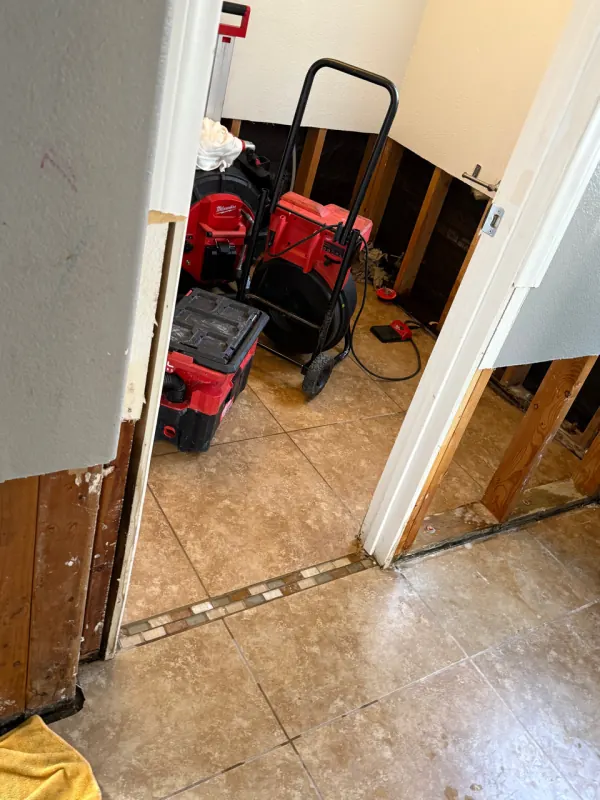
On site, the work starts with measurement, not demolition. We map the wet area with moisture meters and thermal imaging, reading wet zones against a known-dry section of the same ceiling. On gypsum board, comparative readings are what the meters are actually good for. From there, the water's category and the board's condition decide what can be dried in place and what gets removed under containment.
Drying runs until the readings match the dry reference, not until a schedule says stop. Then the rebuild: board, tape, texture matched to your ceiling, primer, paint. Throughout, we document readings and photos in a form you can hand to your insurance carrier. We can't promise what a policy will pay, but we can make sure your claim is built on evidence rather than memory. Our insurance claim assistance page describes that side of the work.
Ceiling repair is one piece of our Water Damage Restoration in Henderson, NV: the full picture from extraction to build-back lives there.
Quality 1st Restoration is based in Henderson and works across the Las Vegas Valley: Las Vegas, North Las Vegas, Summerlin, Paradise, out to Boulder City. The number is 888-453-3591, and it's answered every hour of the year. If your ceiling is stained, bulging, or already down, call before the damage gets a longer story.
Call 888-453-3591Ceiling water damage questions
If your situation does not fit neatly into one answer, call 888-453-3591 and describe what you see.
Q1 How much does ceiling water damage repair cost?
It depends on what the assessment finds: how far the water spread, whether the board can be dried or has to come out, whether insulation and framing got wet, and whether mold has started. A stain caught the week it appeared is not the same job as a sag that's been fed all summer. So we scope after measuring, not before. And we put the findings in writing.
Q2 Is ceiling water damage covered by homeowners insurance?
Policies usually treat sudden events differently from slow, long-term seepage, and we can't promise what your carrier will decide. What we can control is the evidence. That means moisture readings and photos, plus a documented scope of work that supports the claim you file.
Q3 Can I just paint over a water stain on the ceiling?
Not as a fix. The EPA warns against painting over damp or moldy surfaces. The paint tends to peel and the problem keeps going underneath. Once the leak is repaired and the board is verified dry, a stain-blocking primer and paint are the right last step. We include that finish work in the rebuild.
Q4 What does minor ceiling water damage look like?
A small, dry, stable ring, often with a darker edge, from a one-time event that's already been fixed. "Minor" is doing a lot of work in that sentence, though. The stain shows where water exited, not how much stayed inside. If the ring grows, feels soft, or came with a musty smell, treat it as active.
Q5 How long does the ceiling take to dry before it can be rebuilt?
Until the wet areas read the same as a dry reference section, typically a few days with drying equipment running, longer if framing and insulation were involved. Rebuilding over damp board just seals moisture in. The meters set the schedule, not the calendar.
More water damage restoration services in Henderson.
Ceiling Water Damage Repair covers a few specific situations, and each page below goes deeper on one of them. If the damage is bigger than one task, start at the main category page and we'll scope the whole job.
Water Damage Restoration in Henderson, NVPart of Ceiling Water Damage Repair
Related water damage restoration services
- Thermal Imaging Water Detection Thermal imaging to find hidden moisture patterns behind ceilings, walls, and flooring.
- Structural Drying Drying the building itself after water damage, including framing, subfloor and the inside of wall cavities.
- Drywall Repair & Replacement Drywall repair and replacement after leaks, floods, mold removal, fire damage, or demolition.
- Water damage-related mold removal Mold removal tied to water damage, leaks, or hidden moisture. We identify affected materials, contain the area, and remove growth.
Straight answers before you call.
Real questions from Henderson homeowners, answered by the crew that does the work. Read up, then call when you're ready.
All guidesClear work, clean documentation, no mystery in the middle.
For Ceiling Water Damage Repair, you should be able to see what we found and what we did about it. That's what the paperwork is for.
When we leave, you should have a plain explanation of the work and paperwork that still makes sense weeks later if an adjuster asks.
Certified standards
IICRC-certified technicians work to the published industry standards instead of judging the job by how it looks.
Claim-ready documentation
Photos and scope notes are collected as the work moves, so you and your adjuster can see what changed and why.
Measured drying
Crews meter the wet materials before and during the job and move equipment to wherever the readings are still high.
One accountable plan
The emergency work and the rebuild stay under one plan, so nothing falls into the gap between two contractors.
Local loss experience
The team works across Henderson and the Las Vegas Valley, where slab leaks, supply lines, roof leaks and AC drain lines are the usual sources.
What we tell you before work expands
What needs action now
What needs attention today and what can wait. If part of it belongs to a plumber or roofer, we say so.
What should stay closed
We don't open finished walls or ceilings until the readings and the access tell us it's worth it.
What happens next
Stabilize first. Repair decisions come after the building is under control.
Water damage restoration in Henderson, Las Vegas, and nearby communities.
From slab leaks and burst pipes to monsoon water and roof leaks, every water loss starts differently. We identify the source, remove standing water, dry affected materials, and plan the cleanup around the property.
Request emergency water cleanupCoverage
Las Vegas Valley
Las Vegas Henderson Summerlin North Las Vegas Paradise Spring Valley Enterprise Whitney Sunrise Manor Boulder City
Need help with water damage, fire damage, mold, or rebuilding?
Call Quality 1st Restoration. We help homes and businesses across the Las Vegas Valley with water damage restoration, fire and smoke cleanup, mold remediation, and building restoration.