
Water Damage Repair Cost: How a Full Job Breaks Down
Quality 1st Restoration
The short answer
In the Las Vegas Valley, water damage usually starts with mitigation at $1,500 to $4,800. If drywall, flooring or cabinets had to come out, repairs often run about twice the mitigation. Bigger jobs that need both across several rooms often total $12,000 to $20,000. Plenty of leaks never get that far.
Most water damage bills are smaller than people fear. In the Las Vegas Valley, water mitigation (getting the water out and drying the house) usually costs $1,500 to $4,800. If nothing had to be torn out, that can be most of the bill.
Repairs are a second, separate estimate. They only come in when drywall, baseboards, flooring or cabinets had to be removed. As a planning rule from our own jobs, the repairs often run about twice the mitigation. The big numbers you may have seen, $12,000 to $20,000, belong to larger jobs where several rooms need both drying and a full rebuild.
These are planning figures from our work around Henderson and Las Vegas, not a quote for your house. The rest of this page breaks down where each dollar goes.
How much does water damage repair cost?
Here is how a water damage job usually splits into parts:
| Part of the job | What it covers | Typical cost |
|---|---|---|
| Water mitigation | Extraction, removing what can’t dry in place, air movers, dehumidifiers, moisture checks | $1,500 to $4,800 |
| Repairs (build-back) | New drywall, texture, paint, baseboards, flooring, cabinets as needed | Often about 2× the mitigation |
| Larger full jobs | Several rooms needing both mitigation and a full rebuild | Often $12,000 to $20,000 total |
| Mold remediation, if needed | Containment and removal of affected materials | Starts at $2,500 |
The table is the short version. Where your job lands depends on what got wet and what had to come out, which is what the next sections walk through.
Mitigation and repairs are two different bills
Mitigation is the emergency part. The goal is to stop the damage from spreading: pull the water, cut out materials that can’t be dried, and run drying equipment until moisture readings match the dry parts of the house. Our water damage restoration cost guide covers that side in detail.
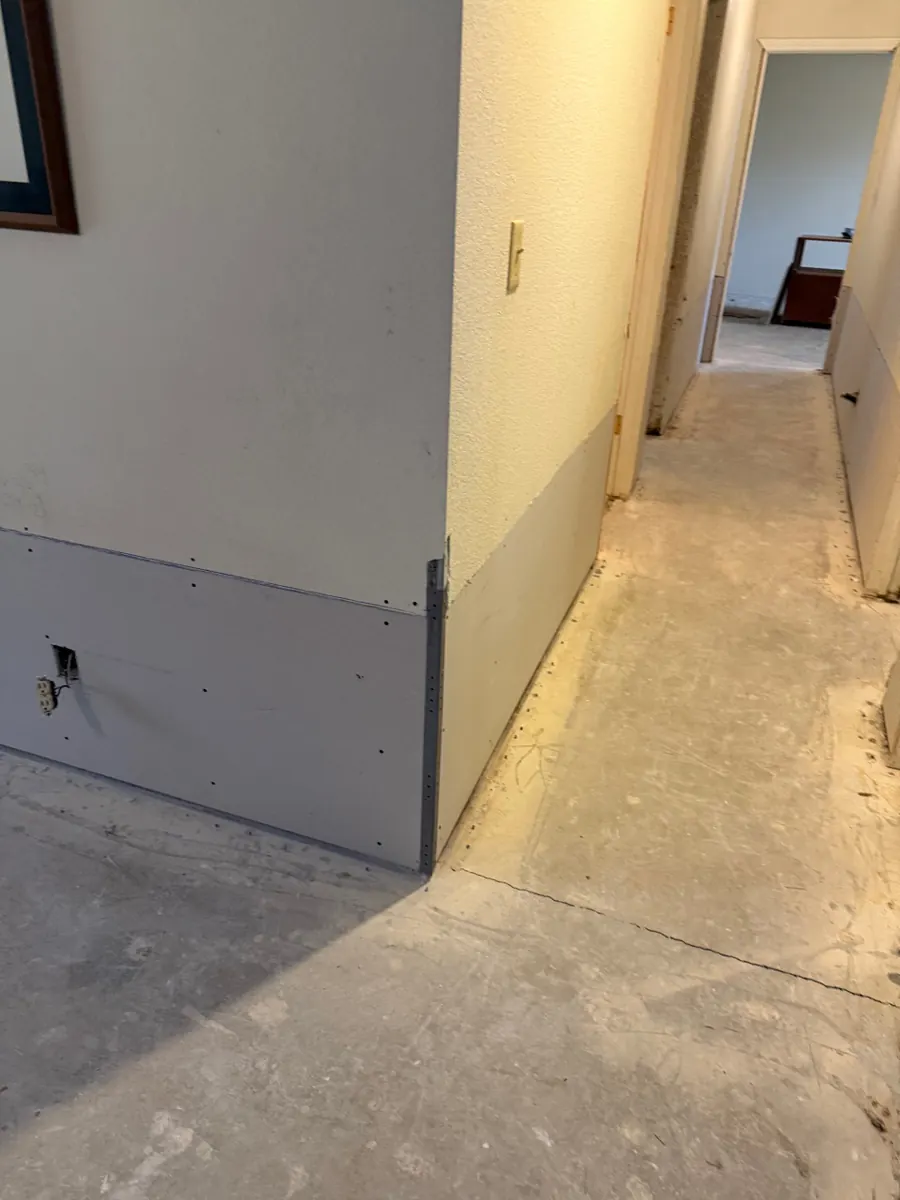
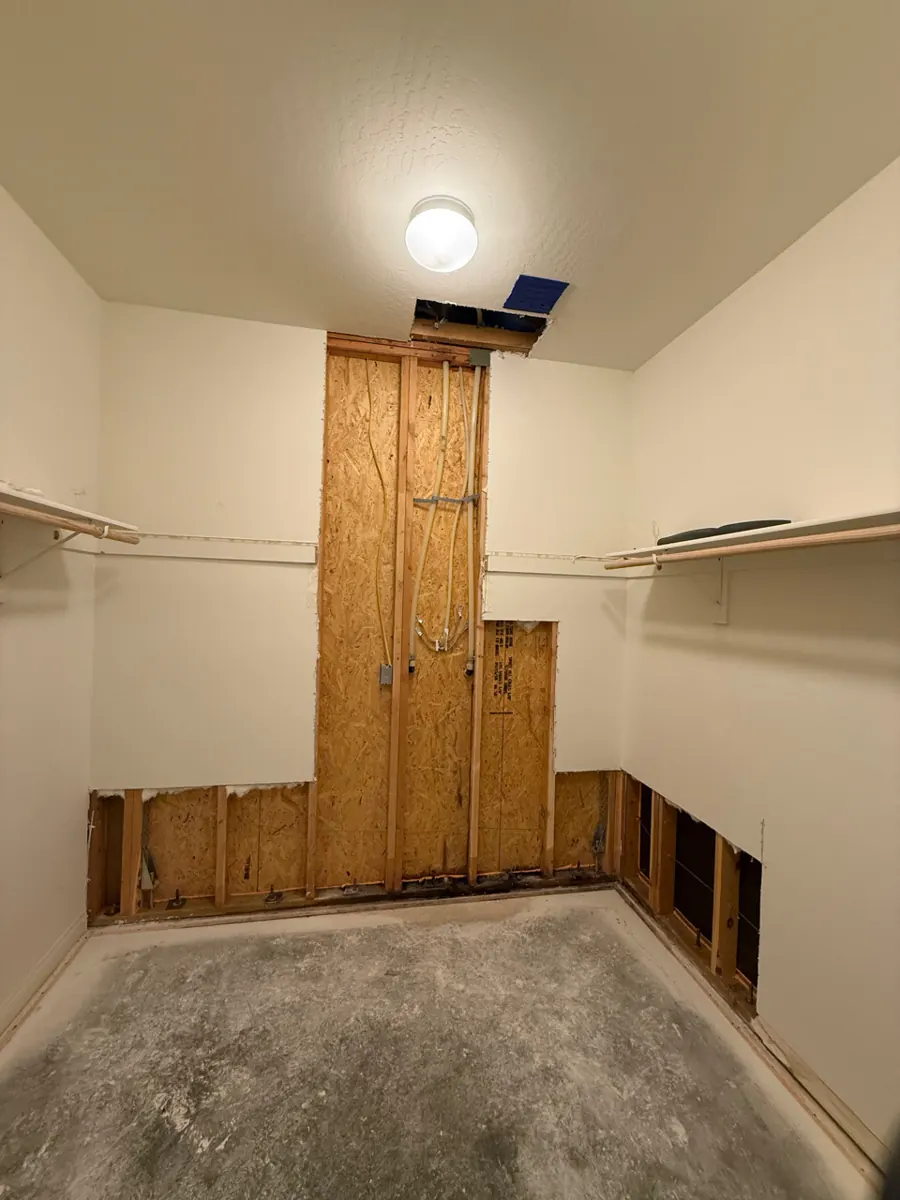
Repairs are everything that goes back afterward. If the crew cut the bottom two feet of drywall in a bedroom, that drywall gets replaced, taped, textured and painted, and the baseboard goes back on. If the flooring came up, new flooring goes down.
Keeping the two separate matters for you in two ways:
- You see what is urgent. Mitigation can’t wait. Repairs can be scheduled once the house is dry and the insurance question is settled.
- Your adjuster sees it clearly. An estimate that lists the drying and the rebuild as separate lines is easier to review than one lump number.
A lot of calls end with mitigation alone. When water is caught early and the materials dry in place, there may be little or nothing to rebuild. That is the best outcome, and it is why speed matters more than anything else on this page.
What goes into a water damage repair estimate?
Repairs are priced line by line, using the same Xactimate software most insurance carriers use. (1) These are the lines that move the number the most:
Drywall and insulation
Wet drywall is usually cut out in a straight line above the water mark, often called a flood cut. Replacing it means new board, tape, mud, texture to match the rest of the wall, primer and paint. Wet insulation behind it comes out too. Ceilings cost more per square foot than walls because the work is overhead.
Texture and paint
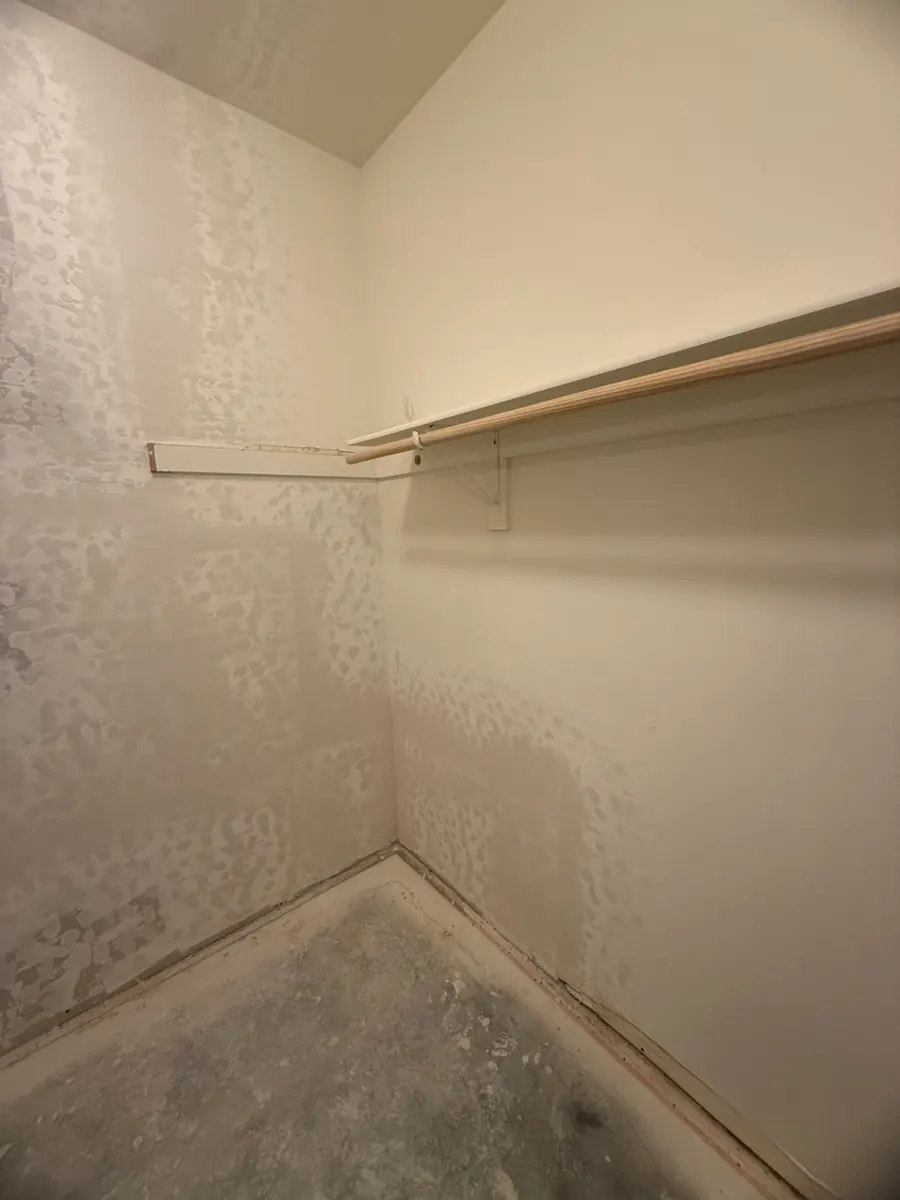
Las Vegas homes are full of knockdown and orange-peel texture. New drywall has to be textured to blend in, and paint rarely stops at the patch. To avoid a visible line, the whole wall, and sometimes the whole room, gets painted.
Baseboards and trim
Baseboards almost always come off during mitigation so the wall can dry. Some can be reused. Painted MDF baseboard that soaked up water usually can’t.
Flooring
Flooring is often the biggest single line. Tile on a concrete slab can sometimes stay. Carpet pad that got wet is usually replaced. Laminate and many vinyl planks swell or trap water underneath and come up. When the same flooring runs through connected rooms, replacing one room can mean replacing more so it all matches.
Cabinets and countertops
Kitchen and bathroom leaks often reach the cabinets. Toe kicks can sometimes be cut out so the space underneath dries. Particleboard cabinet boxes that swelled usually need to be replaced, and pulling base cabinets can mean pulling the countertop with them.
Contents
When a lot of rooms are involved, furniture and belongings may need to be packed out and stored during the work. That is its own line, and it is common on the larger jobs.
Water damage repair cost examples: how the numbers add up
These examples use our planning figures. They are illustrations, not quotes.
| Situation | Mitigation | Repairs | Rough total |
|---|---|---|---|
| Leak caught early, materials dried in place | Low end of $1,500 to $4,800 | Little or none | Mostly the mitigation |
| One room, lower drywall and baseboard removed | About $3,000 | About $6,000 | About $9,000 |
| Several rooms, flooring and cabinets removed | Upper end or more | About twice the mitigation, or more | Often $12,000 to $20,000 |
A real one from our job files: a storm pushed rain through a balcony deck into a home in The Lakes, and the mitigation came to about $3,000. The repairs, including rebuilding the deck, were the bigger and longer piece of that job. You can read the full write-up.
A simple way to estimate your own repair cost
There is no online water damage repair cost calculator that can see inside your walls, but you can rough out a range:
- Start with the mitigation estimate, or use $1,500 to $4,800 as a placeholder.
- Ask what had to come out. If nothing was removed, the repairs may be small.
- If drywall, flooring or cabinets came out, plan for repairs of about twice the mitigation.
- Add the two for a rough total, then compare it with your insurance deductible.
Your on-site estimate replaces all of this with real line items.
Why do bigger jobs land between $12,000 and $20,000?
It is rarely one expensive item. It is the same lines repeated across more of the house:
- More rooms. Each room adds its own drywall, texture, paint and trim.
- Flooring that has to match. A floor that runs through a hallway into three rooms can turn a one-room replacement into a whole-floor job.
- Kitchens and bathrooms. Cabinets, countertops and tile carry more cost than plain walls.
- Contents and moving. Packing out and storing a house full of belongings adds up.
- Water that sat. When drying starts late, more material is wet and more has to come out.
That last one is the one you control. The EPA recommends drying wet materials within 24 to 48 hours to prevent mold growth. (2) Every day past that tends to move a job from the first row of the examples table toward the last.
What makes water damage repair cost more?
Besides the size of the job, a few things push repair costs up:
- The category of water. Clean water from a supply line can often be dried. Gray or black water, like a dishwasher drain or a sewage backup, means more has to be removed. Our guide to types of water damage explains the categories.
- What got wet. Particleboard, carpet pad and MDF trim don’t survive soaking the way tile and solid wood can.
- Matching finishes. Discontinued flooring or custom texture takes more work to blend in.
- Access. Ceilings, second floors and work behind built-ins take longer.
Does insurance pay for water damage repairs?
Often, when the damage came from something sudden and accidental, like a supply line that burst. Your carrier reviews the claim against your policy and decides what it pays after your deductible. (3) Damage that built up from a slow leak, or that got worse because the water was left sitting, is often excluded.
We help with the record: photos, moisture readings and a line-item estimate that separates mitigation from repairs. You decide whether to file. On a smaller job, paying directly can make more sense than a claim, and we offer a self-pay discount.
How to keep the repair bill down
- Stop the water at the shutoff valve if you can do it safely.
- Call right away. The faster drying starts, the more material can stay in place.
- Take photos before anything gets moved or thrown out.
- Ask for separate lines for mitigation and repairs, so you can see and plan each part.
- Ask what can be saved. Tile, solid wood cabinets and some trim can often be dried and kept.
When the drying is done and something has to go back, our build-back services cover drywall, paint, trim and flooring in the order they go back in. For flooring on its own, see flooring replacement. If the water is still on the floor, start with water damage cleanup and repair.
Call or text Quality 1st Restoration at 888-453-3591, any hour. An IICRC-certified technician will come out, check the readings with you and give you a free estimate before anything gets cut.
References
- Verisk, "Xactimate," property claims estimating platform. https://www.verisk.com/products/xactimate/
- U.S. Environmental Protection Agency, "A Brief Guide to Mold, Moisture and Your Home." https://www.epa.gov/mold/brief-guide-mold-moisture-and-your-home
- National Association of Insurance Commissioners, "What You Need to Know When Filing a Homeowners Claim." https://content.naic.org/article/what-you-need-know-when-filing-homeowners-claim
Water still spreading? Every hour it sits, the repair gets bigger.
Quality 1st Restoration answers 24 / 7 / 365 across Henderson and the Las Vegas Valley.
888-453-3591