“Great price. Highly recommend this company for any service or repair.”
Moisture Mapping in Henderson, NV
Moisture mapping is how we find out how far water went and prove when it's gone. We test the walls, floors and cabinets with moisture meters, mark every reading on a sketch of the room and draw the line where wet stops. That sketch decides what we open, what we leave alone and when drying is finished.
In Henderson and across the valley, most homes sit on a concrete slab, so a leak spreads sideways. It moves under flooring, along the bottom of walls and into the room next door. The map follows it there.
24/7 Response
IICRC-Certified
Licensed & Insured
Insurance Support
Google Reviews
10 reviews with a five-star rating.
Real customer experiences from Quality 1st Restoration across water damage, mold, repairs, and restoration.
5.0 10 verified reviews
Write a review
“Quality First Restoration is fair and they cared about me. They helped me through the entire process...”
“I was referred to Quality Restorations from an insurance agent. I was impressed that they answered the call...”
“Literally life savers!! I had been dealing with some skin issues...”
“We had a drainage pipe burst inside the wall of our laundry room, and the leak went downstairs...”
“Quality First Restoration is fantastic! The crew did a wonderful job with water damage.”
“I had the opportunity to meet with Todd. He is knowledgeable and responsive. We made the right choice moving forward...”
“The team at Quality First Restorations did a great job taking care of a water leak above our bathroom...”
“Quality First Restoration did an amazing job from start to finish. Professional, responsive, and high-quality work.”
“So I've worked with Todd at Quality First Restorations previously on a rental I have. The tenants had a leak...”
What people ask about the map
Most folks have never seen one before we hand it over. Here's what usually comes up.
What does a moisture map actually look like?
It's a sketch of the room, or the rooms, with a reading written at each spot we tested. Wet readings get circled. A line shows where wet turns to dry. It sounds basic, because it is. It's also the page the rest of the job gets checked against.
Will you have to tear out my walls?
Only the parts the map says are wet. If the bottom foot of a wall reads wet and the rest reads dry, the cut goes a little above the wet line and stops there. A wall that reads dry stays closed, even when it sits right next to the leak.
Why can't you just look and tell me?
Because drywall can feel dry and look fine while the back of it is soaked. Water travels, too. It runs along the bottom plate of a wall, wicks up the drywall, and slides under flooring into the next room. The meter finds that. Your eyes don't.
Will my insurance adjuster accept it?
Adjusters like maps because they can see why each cut was made. Instead of a note that says "removed drywall," the file shows the reading that justified it and the spot it was taken. Your carrier still makes the coverage call.
How do I know when it's actually dry?
We take a reading on a dry wall somewhere else in your house and use it as the target. The wet spots get re-read on the same points each visit. When they match the dry target, the job's done drying, and you've got the numbers to show it.
How much does it cost? Will insurance pay?
Water mitigation in the Las Vegas Valley usually costs $1,500 to $4,800. That covers getting the water out, drying the structure and checking it with moisture meters until the readings are back to normal. If drywall, baseboards or flooring had to come out, the repairs are a separate estimate, so you see each part on its own.
The map is what sets the price. A small wet area with a tight boundary means a short dry-out and few cuts. When the readings run under a wall into a second room, or up into cabinets, there's more to dry and more to rebuild. You'll see that on the sketch before you see it on the estimate.
Water mitigation
$1,500–$4,800
Extraction, drying equipment and moisture checks.
Repairs
Priced separately
Only if drywall, baseboards or flooring had to come out.
Estimate
Free
On site, before any work starts.
Insurance or self-pay, you decide
Insurance usually pays when the water came on suddenly, like a supply line that split overnight. A leak that dripped for months usually isn't covered. Your carrier makes that call, not us.
We handle the record: photos, moisture readings and a line-item estimate built in Xactimate, the same software most adjusters use. Then you compare it with your deductible and decide whether to file.
Ask for a copy of the map for your own records. If the adjuster's scope and ours don't match, the readings are what both sides can look at.
Paying yourself? Ask about the self-pay discount. The estimate is free, and you see the price before we start.
Book a free estimatePlanning figures from our work in the Las Vegas Valley, not a quote for your property.
How we build and use a moisture map
- 1
Take a dry reading first
Before we touch the wet area, we test the same kind of material in an unaffected room. That number is the goal for the whole job.
- 2
Work outward from the water
Readings start where the water was and move out in every direction, along the walls, across the floor and up the drywall, until they come back dry.
- 3
Draw the boundary
Every reading goes on the sketch where it was taken. The wet edge gets a line, so you and your adjuster can see how far it went.
- 4
Decide what opens
The map drives the cut list. Wet drywall that won't dry in place comes out. Wet materials that can dry where they are get equipment instead.
- 5
Re-read the same points daily
Each check uses the same marked spots, so the numbers show whether each area is drying, stalled or getting worse. Equipment moves based on that.
- 6
Close it out against the target
When every point matches the dry reading, the equipment leaves. The finished map goes in the file with the photos.
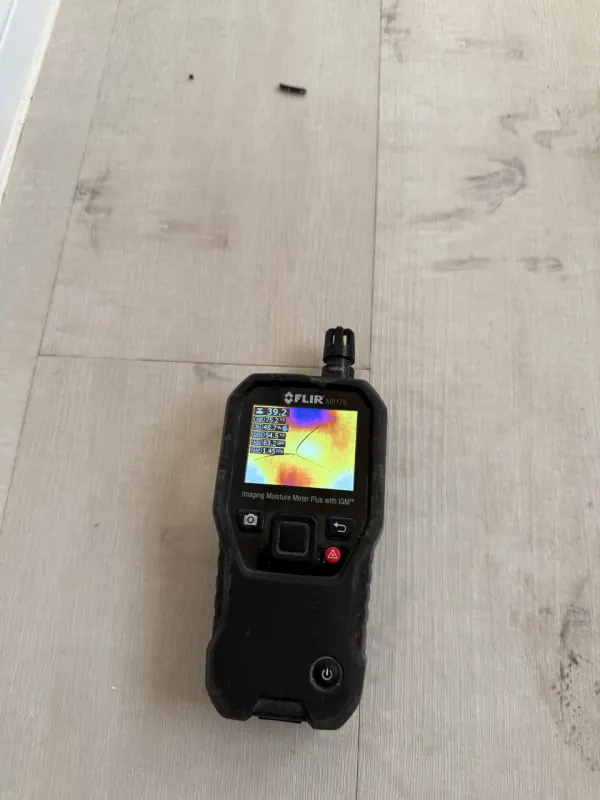
Every mark on the map is a reading someone took.
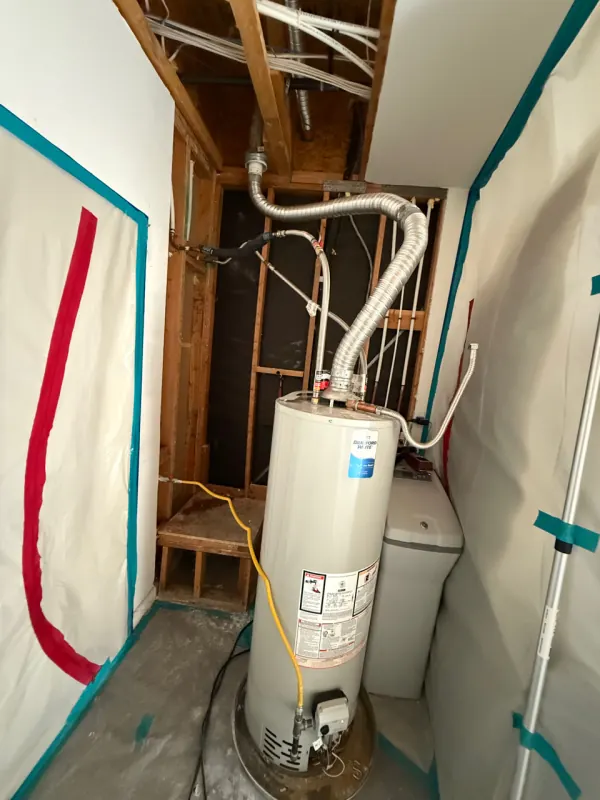
A thermal camera can point us toward a suspect spot, but it only sees temperature. The map is built from meter readings taken in the material itself, and the thermal image is just where we start looking.
That's why the map is worth keeping. A year from now, if a stain shows up and someone asks whether that wall was dry, the answer is on paper.
The EPA's professional moisture guide includes verification tests and checklists for confirming whether moisture controls are working; see its building moisture verification resources .
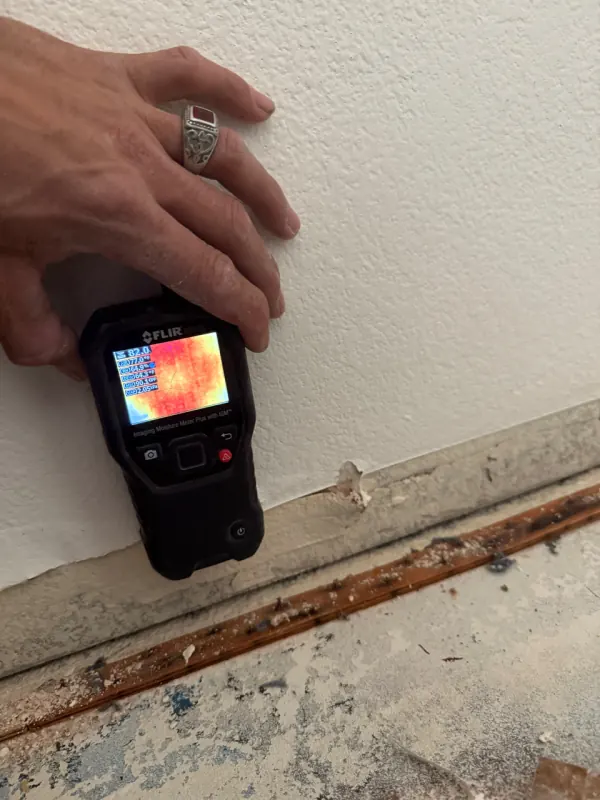
Pulled baseboards and a low cut, because that's where the readings were.
Say a supply line under a bathroom sink let go overnight. The map might show the vanity base wet, the hallway wall wet for a few feet at the bottom, and the bedroom on the other side reading dry. So the hallway gets a low cut and the bedroom wall stays closed.
Smaller cuts are cheaper to patch and faster to rebuild. And there's less dust in your house.
What you get
Mapping comes with every water job we dry. Here's what it covers and where it stops.
What we do
- A dry reference reading from an unaffected part of the house
- Meter readings on walls, floors, baseboards and cabinet bases around the loss
- A sketch with every reading marked and the wet boundary drawn
- A cut list tied to the map, so removal stays inside the wet area
- Daily re-reads on the same points until everything matches the dry target
- The final map, photos and readings for your insurance file
What we don't do
- Finding or fixing the broken pipe inside the wall. That's a plumber.
- Roof leak repair. A roofer fixes the roof, and we map and dry what got wet below it.
- Mold removal. If the map leads us to growth behind a wall, that's quoted as its own job.
Mapping is one part of our water leak detection work. If you want to know what the camera can and can't show before we bring out the meters, see thermal imaging water detection.
Moisture mapping questions
What is moisture mapping in water damage restoration?
It's the record of where the water went. We test materials with moisture meters, write each reading on a sketch of the room and draw the line where wet turns to dry. That map decides what gets removed, where drying equipment goes and when the job is finished.
How much does moisture mapping cost?
Mapping is part of drying a water loss, so it's priced inside the dry-out, which usually runs $1,500 to $4,800 in the Las Vegas Valley. The estimate is free, and you see the number before any work starts.
Is moisture mapping covered by homeowners insurance?
When the water damage itself is covered, the mapping is usually treated as part of that claim, since it's how the damage is measured. If the loss isn't covered, the map won't change that. Your carrier decides, and we give them the readings either way.
How long does moisture mapping take?
The first map is done on the first visit, before any demolition. After that, re-reading the marked points takes much less time. Drying usually runs three to five days, and the map gets updated at each check.
Can you map moisture after the water is already cleaned up?
Yes, and that's often when people call. The floor is dry and the stain's been wiped, but the baseboards are swelling or there's a musty smell. The meter still finds what's left in the drywall, subfloor or cabinet base.
More water damage restoration services in Henderson.
Moisture Mapping is one part of Water Leak Detection. The pages below cover the rest of that job and the related water damage restoration work around it.
Water Damage Restoration in Henderson, NVPart of Water Leak Detection
Related water damage restoration services
- Structural Drying Drying the building itself after water damage, including framing, subfloor and the inside of wall cavities.
- Dehumidification Services Dehumidification after leaks, floods, or high humidity water losses to protect building materials.
- Mold inspection Mold inspection for visible growth, musty odors, and moisture concerns.
- Roof Leak Water Damage Roof leak water damage cleanup after storms, wind, or damaged roofing.
- AC Leak Damage Cleanup AC leak cleanup for ceiling stains, wet drywall, and moisture from condensate line issues.
Straight answers before you call.
Real questions from Henderson homeowners, answered by the crew that does the work. Read up, then call when you're ready.
All guidesClear work, clean documentation, no mystery in the middle.
For Moisture Mapping, you should be able to see what we found and what we did about it. That's what the paperwork is for.
When we leave, you should have a plain explanation of the work and paperwork that still makes sense weeks later if an adjuster asks.
Certified standards
IICRC-certified technicians work to the published industry standards instead of judging the job by how it looks.
Claim-ready documentation
Photos and scope notes are collected as the work moves, so you and your adjuster can see what changed and why.
Measured drying
Crews meter the wet materials before and during the job and move equipment to wherever the readings are still high.
One accountable plan
The emergency work and the rebuild stay under one plan, so nothing falls into the gap between two contractors.
Local loss experience
The team works across Henderson and the Las Vegas Valley, where slab leaks, supply lines, roof leaks and AC drain lines are the usual sources.
What we tell you before work expands
What needs action now
What needs attention today and what can wait. If part of it belongs to a plumber or roofer, we say so.
What should stay closed
We don't open finished walls or ceilings until the readings and the access tell us it's worth it.
What happens next
Stabilize first. Repair decisions come after the building is under control.
Water damage restoration in Henderson, Las Vegas, and nearby communities.
From slab leaks and burst pipes to monsoon water and roof leaks, every water loss starts differently. We identify the source, remove standing water, dry affected materials, and plan the cleanup around the property.
Request emergency water cleanupCoverage
Las Vegas Valley
Las Vegas Henderson Summerlin North Las Vegas Paradise Spring Valley Enterprise Whitney Sunrise Manor Boulder City
Need help with water damage, fire damage, mold, or rebuilding?
Call Quality 1st Restoration. We help homes and businesses across the Las Vegas Valley with water damage restoration, fire and smoke cleanup, mold remediation, and building restoration.