“Great price. Highly recommend this company for any service or repair.”
Water Softener Leak Cleanup in Las Vegas & Henderson, NV
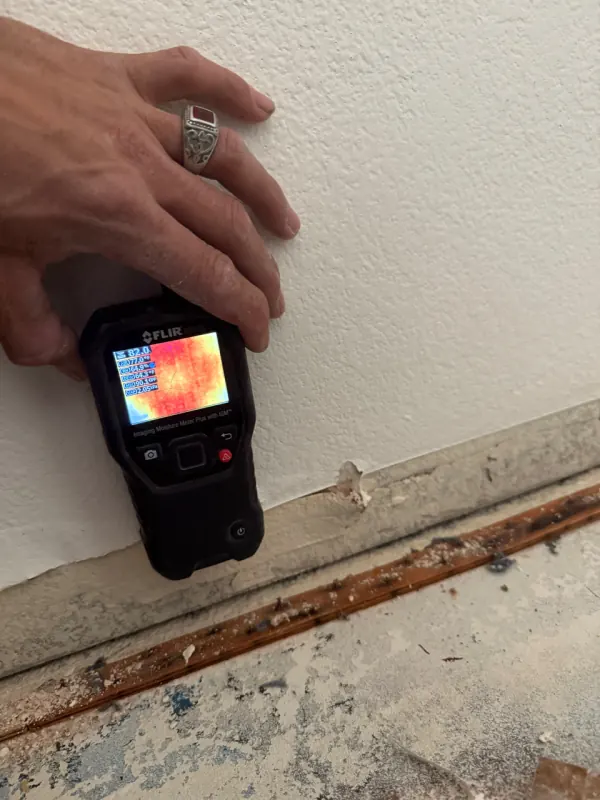
Water softener leaking? Put the unit on bypass (that routes your home's water around it instead of through it), leave the tank alone, and call us. We pull up the water, check the wall and the room behind it with moisture meters, dry everything out, and repair the baseboards and drywall it reached. Fixing or replacing the softener itself is a plumber or water-treatment company's job, and we'll tell you that straight.
A puddle at the base of a softener rarely tells you what caused it. It could be condensation, a cracked fitting, a clogged drain line or something more serious inside the brine or resin tank. The water often starts higher on the unit and runs down before it reaches the floor, so guessing at the source from a wet baseboard is a bad bet. Call 888-453-3591. Someone answers, day or night.
24/7 Response
IICRC-Certified
Licensed & Insured
Insurance Support
Google Reviews
10 reviews with a five-star rating.
Real customer experiences from Quality 1st Restoration across water damage, mold, repairs, and restoration.
5.0 10 verified reviews
Write a review
“Quality First Restoration is fair and they cared about me. They helped me through the entire process...”
“I was referred to Quality Restorations from an insurance agent. I was impressed that they answered the call...”
“Literally life savers!! I had been dealing with some skin issues...”
“We had a drainage pipe burst inside the wall of our laundry room, and the leak went downstairs...”
“Quality First Restoration is fantastic! The crew did a wonderful job with water damage.”
“I had the opportunity to meet with Todd. He is knowledgeable and responsive. We made the right choice moving forward...”
“The team at Quality First Restorations did a great job taking care of a water leak above our bathroom...”
“Quality First Restoration did an amazing job from start to finish. Professional, responsive, and high-quality work.”
“So I've worked with Todd at Quality First Restorations previously on a rental I have. The tenants had a leak...”
Where is the water actually coming from?
Not every leak is the same leak.
- 01 Condensation on the tank's exterior. It's the mildest explanation, and it tends to stop on its own
- 02 A punctured brine tank: the classic mechanical cause is someone breaking up a hardened salt bridge inside the tank with a broom handle or similar tool, cracking the plastic in the process
- 03 A loose, kinked, or blocked drain line, which will also pool water at the base
- 04 Worn O-rings at the bypass valve, or a leak at the control-valve connection that runs down the outside of the tank before it hits the floor
- 05 A cracked resin tank: less common, but more serious, usually a sign of an aging system
That's also why diagnosing a bottom puddle by eye is unreliable. Per Culligan's own guide to a leaking water softener, a leak can start well above the base and travel down the tank before it's visible at all. Our water leak detection page covers how we trace a leak path before anyone opens anything up.
How much does it cost? Will insurance pay?
Water mitigation in the Las Vegas Valley usually costs $1,500 to $4,800. That covers getting the water out, drying the structure and checking it with moisture meters until the readings are back to normal. If drywall, baseboards or flooring had to come out, the repairs are a separate estimate, so you see each part on its own.
A softener stays connected to your water supply, so the biggest price factor is how long it ran before someone put it on bypass. A leak on a bare garage slab is usually a short dry-out. It costs more when the water got under the baseboard into a finished room on the other side, especially one with carpet pad or laminate.
Water mitigation
$1,500–$4,800
Extraction, drying equipment and moisture checks.
Repairs
Priced separately
Only if drywall, baseboards or flooring had to come out.
Estimate
Free
On site, before any work starts.
Insurance or self-pay, you decide
Insurance usually pays when the water came on suddenly, like a supply line that split overnight. A leak that dripped for months usually isn't covered. Your carrier makes that call, not us.
We handle the record: photos, moisture readings and a line-item estimate built in Xactimate, the same software most adjusters use. Then you compare it with your deductible and decide whether to file.
Paying yourself? Ask about the self-pay discount. The estimate is free, and you see the price before we start.
Book a free estimatePlanning figures from our work in the Las Vegas Valley, not a quote for your property.
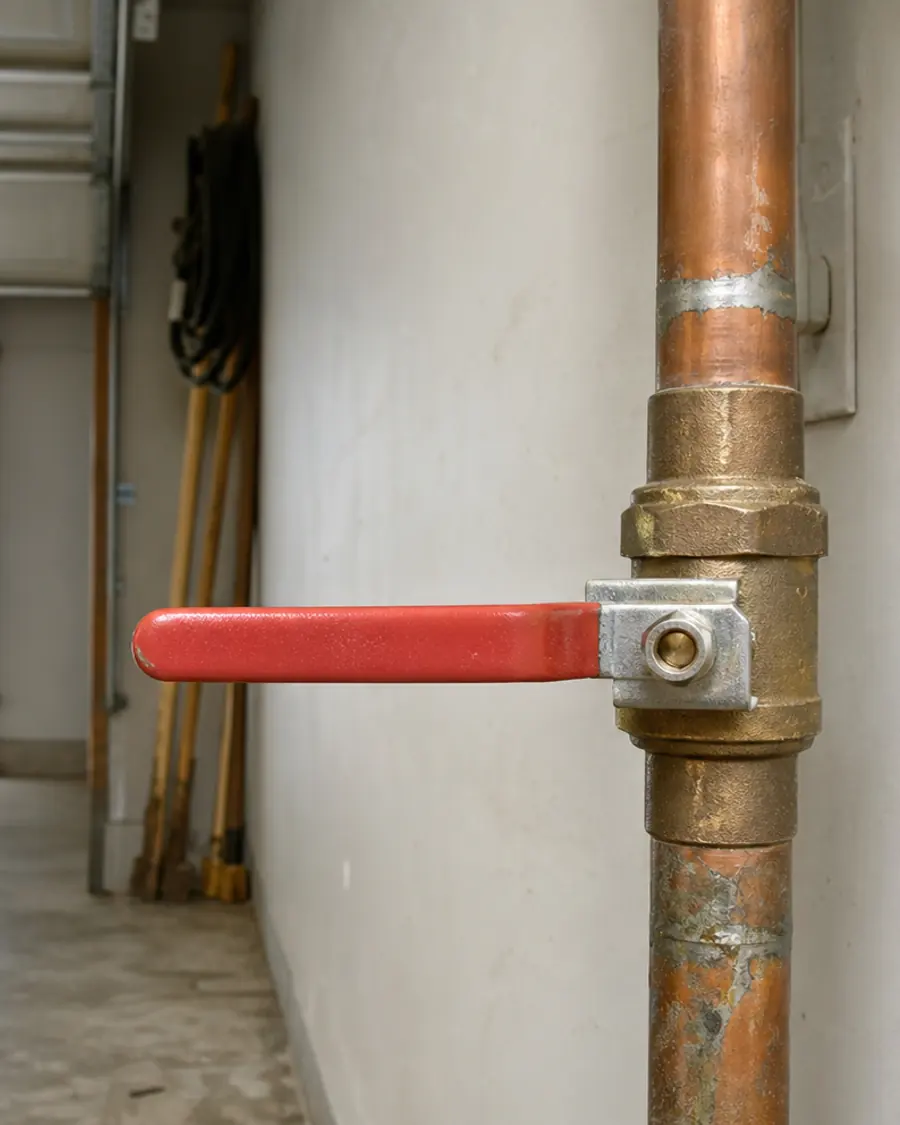
Bypass valve first, floor second
Manufacturers agree on the order of operations: locate the bypass valve and put the softener on bypass, or shut off the water supply to the unit entirely, before doing anything else. Don't disconnect fittings, open the tank or patch a crack yourself. That's professional-service territory. Once the water's stopped, the floor becomes the priority.
Softeners usually sit against a wall in a garage or utility room. On the jobs we see, water from a floor-level leak doesn't stay put: it travels under the baseboard into the room on the other side before it ever pools somewhere visible. That's a field observation from our own calls, not a rule every leak follows, but it's common enough that we check the far side of that wall as a matter of course. If the leak turns out to be a nearby water heater rather than the softener, our water heater leak cleanup page covers that separate appliance. The two often sit side by side. Either way, moisture mapping is where the real assessment starts: how far the water traveled, not just where it's visible.
When a softener leak becomes a water damage job
A softener is plumbed straight into your home's water supply, so a leak isn't a fixed amount of water. It keeps flowing until the unit is bypassed or the supply is shut off. That's the difference between a leak caught in an hour and one that's been running since before anyone got home.
Water leaving the supply side of a softener starts out clean, classified as Category 1, the same category assigned to a broken supply line elsewhere in the house. Clean doesn't mean harmless if it sits, though. Left standing, water damage can begin shifting toward conditions that support mold growth within roughly a day or two, which is part of why the EPA's guidance on mold and moisture is built around fast drying, not cleanup after the fact.
From there, the sequence is always the same. We extract the standing water and map how far it traveled. Structural drying runs until the material reads dry against a known-good reference. Then we repair whatever didn't survive, usually the drywall and baseboards, sometimes flooring. That's the full arc of what we call Water Damage Restoration in Henderson, NV, and a softener leak is one way a job like that starts.
Why softener failures are a Las Vegas thing
This valley is part of why softeners are common here in the first place. The Las Vegas Valley Water District puts local water hardness at roughly 16 to 17 grains per gallon ("very hard" by its own classification), with the minerals traced back to Colorado River water feeding Lake Mead. The Southern Nevada Water Authority backs the same range and explains the basic trade a softener makes: calcium and magnesium swapped for sodium or potassium as water passes through the resin. Upgrade or standard equipment? Out here, closer to standard.
Standard equipment still wears out. A typical softener's service life runs about 10 to 15 years, and the failure points that show up late in that window (a cracked resin tank, a rotor valve seal finally giving out) tend to be the more serious ones. The brine tank often fails the same way: a hardened salt bridge gets broken up by force, and the tool used to do it punches through the plastic at the bottom of the tank. It's a leak source, not a water-quality problem. A puncture means water on the floor, not contaminated water in the pipes.
What happens when you call
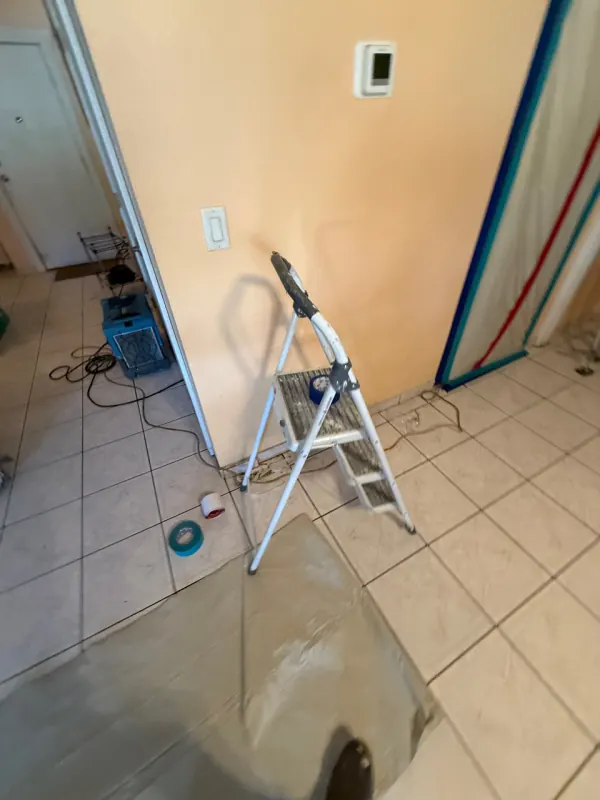
Call 888-453-3591 and the phone gets answered, 24 hours a day. The visit starts with assessment: where the water came from, how far it traveled, what it touched. We take moisture readings and photograph the area as we go, which matters later if you're filing a claim. Our insurance claim assistance page covers how we document a loss so it holds up with an adjuster.
We can't promise what a policy will pay. That's between you and your carrier. What we can guarantee is that the paperwork isn't built from memory. Drying runs until the material matches a dry reference point, and the rebuild (baseboards, drywall, flooring) gets matched to what was there before.
Quality 1st Restoration is based in Henderson and works throughout the Las Vegas Valley: Las Vegas, North Las Vegas, Summerlin, Paradise, out to Boulder City. If your softener is leaking and you're not sure whether it's condensation or something worse, call 888-453-3591. We'll help you sort out which one it is. And if it's ours to fix, we'll get started.
Call 888-453-3591Water softener leak questions
If your situation does not fit neatly into one answer, call 888-453-3591 and describe what you see.
Q1 Why is my water softener leaking from the bottom?
Usually one of four things: condensation on the tank, a brine-tank problem, a loose or blocked drain line, or a valve connection leaking higher up and running down the tank before it pools. A cracked resin tank is less common but more serious, and usually shows up in older units. The leak point and the puddle aren't always in the same place.
Q2 Can I still use my water with the softener on bypass?
Yes. Bypassing the unit routes your home's water supply around it instead of through it, so your water keeps running. It just won't be softened until the unit is repaired or replaced.
Q3 Is water softener leak water dirty?
At the point it leaves the supply side of the unit, it's clean water, the same category assigned to a broken supply line elsewhere in the house. It doesn't stay that way indefinitely. Left sitting, it can start creating the conditions mold needs within a day or two, which is why we treat a fast response as part of the job.
Q4 Will insurance cover a softener leak?
It depends on your policy and how the leak happened. Sudden, accidental failures are typically treated differently than damage from a unit that's clearly been leaking for a long time. We don't make coverage promises. That's the carrier's call. What we do is document the loss with moisture readings and photos, plus a written scope, so your claim is built on evidence.
Q5 Should I repair or replace the softener?
Not our call, and we won't pretend otherwise. A plumber or water-treatment company can tell you whether the unit is worth repairing or has reached the end of a typical 10-to-15-year service life. Our job starts once you know the answer: repairing whatever the leak damaged before it was caught.
More water damage restoration services in Henderson.
Water Softener Leak Cleanup is one part of Burst Pipe Cleanup. The pages below cover the rest of that job and the related water damage restoration work around it.
Water Damage Restoration in Henderson, NVPart of Burst Pipe Cleanup
- Burst Pipe Cleanup Burst pipe cleanup after broken supply lines, frozen lines, slab leaks, or pipe failures.
- Plumbing
- Water Heater Leak Cleanup
- Water Softener Leak Cleanup · this page
Related water damage restoration services
- Moisture Mapping Moisture mapping to locate hidden water behind walls, under flooring, and inside building materials.
- Structural Drying Drying the building itself after water damage, including framing, subfloor and the inside of wall cavities.
- Drywall Repair & Replacement Drywall repair and replacement after leaks, floods, mold removal, fire damage, or demolition.
- Water damage removal Fast water damage removal for standing water from leaks, floods, burst pipes, or appliance failures. We extract water and start drying to limit damage.
- Insurance Claim Assistance Photos, readings and a line-item estimate for your water damage claim. Your carrier decides coverage; we make the record clear.
Clear work, clean documentation, no mystery in the middle.
For Water Softener Leak Cleanup, you should be able to see what we found and what we did about it. That's what the paperwork is for.
When we leave, you should have a plain explanation of the work and paperwork that still makes sense weeks later if an adjuster asks.
Certified standards
IICRC-certified technicians work to the published industry standards instead of judging the job by how it looks.
Claim-ready documentation
Photos and scope notes are collected as the work moves, so you and your adjuster can see what changed and why.
Measured drying
Crews meter the wet materials before and during the job and move equipment to wherever the readings are still high.
One accountable plan
The emergency work and the rebuild stay under one plan, so nothing falls into the gap between two contractors.
Local loss experience
The team works across Henderson and the Las Vegas Valley, where slab leaks, supply lines, roof leaks and AC drain lines are the usual sources.
What we tell you before work expands
What needs action now
What needs attention today and what can wait. If part of it belongs to a plumber or roofer, we say so.
What should stay closed
We don't open finished walls or ceilings until the readings and the access tell us it's worth it.
What happens next
Stabilize first. Repair decisions come after the building is under control.
Water damage restoration in Henderson, Las Vegas, and nearby communities.
From slab leaks and burst pipes to monsoon water and roof leaks, every water loss starts differently. We identify the source, remove standing water, dry affected materials, and plan the cleanup around the property.
Request emergency water cleanupCoverage
Las Vegas Valley
Las Vegas Henderson Summerlin North Las Vegas Paradise Spring Valley Enterprise Whitney Sunrise Manor Boulder City
Need help with water damage, fire damage, mold, or rebuilding?
Call Quality 1st Restoration. We help homes and businesses across the Las Vegas Valley with water damage restoration, fire and smoke cleanup, mold remediation, and building restoration.