“Great price. Highly recommend this company for any service or repair.”
Antimicrobial Treatment in Henderson, NV
Antimicrobial treatment is a product we apply to cleaned surfaces after mold removal, a sewage backup or a dirty-water leak. It helps keep bacteria and mold from taking hold on the framing and subfloor that stay in your house. It doesn't replace removing moldy material or cleaning. Spraying it over growth and calling the job done skips the real work.
We use EPA-registered products and apply them the way the label says, including how long the surface has to stay wet for it to work. On Category 2 and Category 3 water in Henderson homes, it's a routine step. On a clean supply-line leak that dried fast, it often isn't needed, and we'll say so.
24/7 Response
IICRC-Certified
Licensed & Insured
Insurance Support
Google Reviews
10 reviews with a five-star rating.
Real customer experiences from Quality 1st Restoration across water damage, mold, repairs, and restoration.
5.0 10 verified reviews
Write a review
“Quality First Restoration is fair and they cared about me. They helped me through the entire process...”
“I was referred to Quality Restorations from an insurance agent. I was impressed that they answered the call...”
“Literally life savers!! I had been dealing with some skin issues...”
“We had a drainage pipe burst inside the wall of our laundry room, and the leak went downstairs...”
“Quality First Restoration is fantastic! The crew did a wonderful job with water damage.”
“I had the opportunity to meet with Todd. He is knowledgeable and responsive. We made the right choice moving forward...”
“The team at Quality First Restorations did a great job taking care of a water leak above our bathroom...”
“Quality First Restoration did an amazing job from start to finish. Professional, responsive, and high-quality work.”
“So I've worked with Todd at Quality First Restorations previously on a rental I have. The tenants had a leak...”
What people want to know before we spray anything
Fair questions. It's a chemical going on the bones of your house.
Will this kill the mold?
On a surface that's already been cleaned, it can handle what's left and slow regrowth. It won't fix mold inside drywall or insulation. That material has to come out first. No spray changes that.
Is it safe for my kids and pets?
The products we use are EPA-registered for the job, and we follow the label for how to apply them and when people can come back in. Keep kids and pets out until we say the area is ready. We'll tell you the product name so you can read the label yourself.
Why clean first? Isn't the spray the cleaning?
No. Dirt, dust and the slimy film on wet surfaces keep the product from reaching the material. Spray a dirty stud and you've mostly treated the dirt. We clean it, then treat it, then dry it.
Is it needed after a sewage backup?
On everything that stays, yes. Sewage is Category 3 water. After the water is out and the soaked drywall and pad are gone, the framing, subfloor and slab left behind get cleaned and treated before drying.
Does it keep mold from ever coming back?
Nothing does that. If the wall gets wet again, mold can grow again. Fixing the leak and drying the structure do more to prevent regrowth than any product we could put on it.
How much does it cost? Will insurance pay?
Mold remediation usually starts at $2,500. The final price depends on how far the growth has spread and how much drywall, insulation or cabinet material has to be cut out. We price the containment too, because that's the part that protects your family's health.
Antimicrobial treatment is usually one line on a bigger job. What changes the cost is how many square feet get treated. After a sewage backup, every surface that stays gets done. After mold removal, it's usually the framing left in the open wall.
Mold remediation
Starts at $2,500
Containment, removal and cleanup of the affected area.
Rebuild
Priced separately
Drywall or cabinets that had to be cut out.
Estimate
Free
On site, before any work starts.
Insurance or self-pay, you decide
Insurance is harder with mold. Many policies exclude it or cap it low, and most will only review it if it came from a covered water event, like a pipe that burst.
We record where the moisture came from so your adjuster can see the cause, not just the growth. Your carrier decides what the policy pays.
Paying yourself? Ask about the self-pay discount. The estimate is free, and you see the price before we start.
Book a free estimatePlanning figures from our work in the Las Vegas Valley, not a quote for your property.
Where antimicrobial treatment fits in the job
- 1
Remove what can't be saved
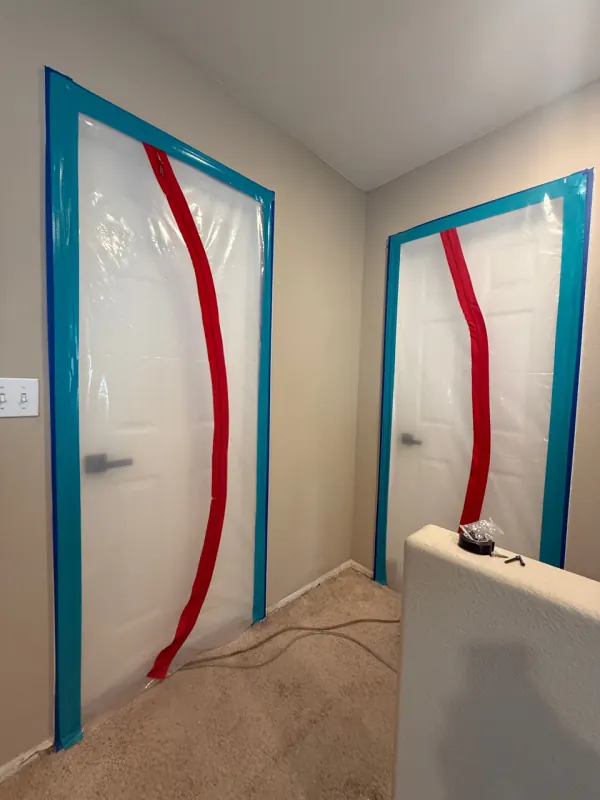
The area gets sealed off with plastic first. Then soaked or moldy drywall, insulation and carpet pad come out before any product goes on. Treating material that's going to the dumpster wastes product and money.
- 2
Clean what stays
Framing, subfloor and slab get HEPA-vacuumed and washed with detergent so the product can reach the surface.
- 3
Match the product to the job
Each EPA-registered product lists what it's for and which surfaces it can go on. Sewage, mold and clean-water jobs don't always call for the same one.
- 4
Apply it and leave it wet
It's sprayed or wiped on, then left for the contact time on the label. Wiping it off early means it didn't have time to work.
- 5
Dry it down
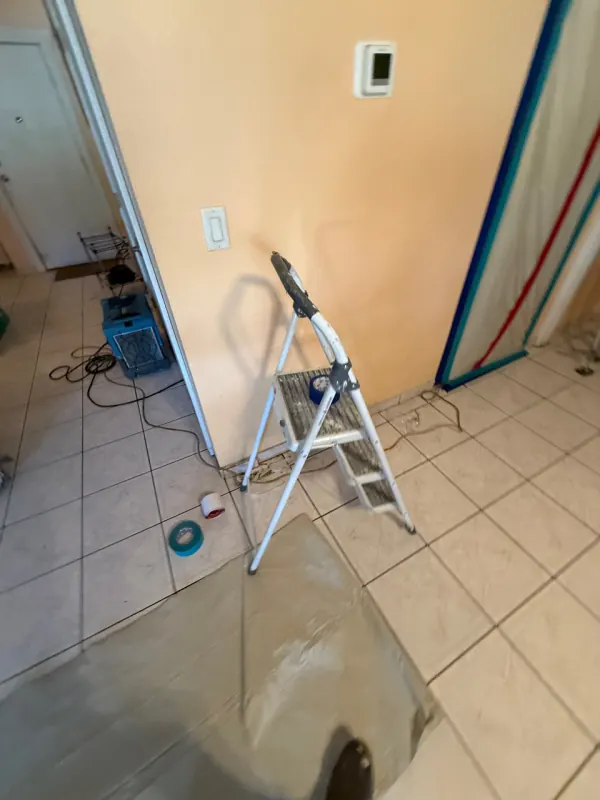
Dehumidifiers and air movers run until the treated material reads dry.
- 6
Write it down
Product, area, date and method go on the job record. If your carrier asks whether it was done, there's an answer on paper.
Antimicrobials work on clean surfaces, not on top of dirt.
Spraying a product over wet, contaminated material doesn't leave you with a clean surface. The product needs to touch the material itself to do anything.
So the order is fixed on our jobs: extract the water, remove what can't be saved, clean, treat, then dry. We note each step as it happens.
Product selection and contact time come from the approved label, as explained in the EPA's registered disinfectant guidance .
What's included
Treatment is part of a larger job. Here's what we do and where we stop.
What we do
- Cleaning surfaces before any product goes on
- An EPA-registered antimicrobial applied according to its label
- Treating framing, subfloor and slab left after removal
- Drying the treated area with dehumidifiers
- Product name, area and method recorded for your claim
What we don't do
- Spraying over mold that should be removed. We cut it out first.
- Sewer line or plumbing repair. That's a plumber.
Antimicrobial treatment questions
What is antimicrobial treatment in water damage restoration?
It's an EPA-registered product applied to cleaned framing, subfloor and other surfaces after a water, sewage or mold job. It's there to limit bacteria and mold on what stays. One step near the end. Not the job itself.
Is antimicrobial treatment the same as mold removal?
No. Mold removal means containing the area and cutting out the moldy material. Antimicrobial goes on what's left after that, once it's been cleaned. If someone offers to spray mold instead of removing it, ask them what happens to the growth inside the wall.
Do you use antimicrobial after every water leak?
No. On a clean-water leak that got dried quickly, cleaning and drying usually cover it. It becomes routine when the water was Category 2 or 3, when mold was removed, or when water sat long enough that we can't treat it as clean anymore.
How much does antimicrobial treatment cost?
It's usually one line on a drying, sewage or mold estimate, priced by the area treated. It isn't usually a job by itself. The estimate is free, and you'll see that line before we start.
Does insurance pay for antimicrobial treatment?
When it's part of a covered water or sewage loss, it usually appears as a line in the claim. Your carrier decides what the policy pays. Our record shows what product went where, so there's no question it was done.
How long do we stay out after treatment?
That comes from the product label, and it differs between products. We'll tell you the re-entry instructions for what we used before we leave.
More mold remediation services in Henderson.
Antimicrobial Treatment is one part of our mold remediation work. If the damage is bigger than one task, start at the main category page and we'll scope the whole job.
Mold Remediation in Las Vegas and HendersonRelated mold remediation services
- Mold Removal Las Vegas Mold removal for Las Vegas and Henderson homes: inspection, containment, removal of affected materials, and the moisture control that keeps it from coming back.
- Mold remediation Contained mold removal to IICRC S520, from sealing off the area to the final clearance check.
- Mold inspection Mold inspection for visible growth, musty odors, and moisture concerns.
- Water damage-related mold removal Mold removal tied to water damage, leaks, or hidden moisture. We identify affected materials, contain the area, and remove growth.
- Mold cleaning Mold cleaning for affected surfaces and materials after leaks, humidity, or water damage.
- Mold mitigation Mold mitigation to limit spread, protect unaffected areas, and begin safe cleanup.
Straight answers before you call.
Real questions from Henderson homeowners, answered by the crew that does the work. Read up, then call when you're ready.
All guidesClear work, clean documentation, no mystery in the middle.
For Antimicrobial Treatment, you should be able to see what we found and what we did about it. That's what the paperwork is for.
When we leave, you should have a plain explanation of the work and paperwork that still makes sense weeks later if an adjuster asks.
Certified standards
IICRC-certified technicians work to the published industry standards instead of judging the job by how it looks.
Claim-ready documentation
Photos and scope notes are collected as the work moves, so you and your adjuster can see what changed and why.
Contained removal
We seal the work area with plastic and run HEPA air scrubbers, so spores stay where we're working instead of drifting into bedrooms.
One accountable plan
The emergency work and the rebuild stay under one plan, so nothing falls into the gap between two contractors.
Local loss experience
In a climate this dry, mold usually points to a hidden leak. We find the water first so the growth doesn't come back after we leave.
What we tell you before work expands
What needs action now
What needs attention today and what can wait. If part of it belongs to a plumber or roofer, we say so.
What should stay closed
We don't open finished walls or ceilings until the readings and the access tell us it's worth it.
What happens next
Stabilize first. Repair decisions come after the building is under control.
Mold remediation in Las Vegas, Henderson, and nearby communities.
Leaks, AC condensation, and storm intrusion can leave hidden moisture inside walls, flooring, and cabinets. We identify the affected area, explain the remediation path, and help correct the moisture conditions behind the growth.
Request mold helpCoverage
Las Vegas Valley
Las Vegas Henderson Summerlin North Las Vegas Paradise Spring Valley Enterprise Whitney Sunrise Manor Boulder City
Concerned about mold or hidden moisture in Las Vegas now?
Call Quality 1st. We identify the moisture concern, explain the inspection or remediation path, and help you take the next safe step.