We handle the damage.
Moisture mapping, extraction and drying of what can be saved, removal of what can't, and the rebuild to a matched finish.
No room in the house packs more supply connections into less floor space than the bathroom. A toilet has its own supply line and shutoff. The sink has two. The shower or tub has a valve body and, often, a filter cartridge sitting in the line. Every one of those is a place water is meant to stay inside a pipe — and a place it eventually doesn't.
Bathroom water damage shows up two ways: a blowout, where a line lets go and water is on the floor in minutes, or a seep, where a slow drip or a failing wax ring wets the subfloor a little at a time for weeks before anything looks wrong. Quality 1st Restoration handles what that water did. We dry the space, remove what can't be saved, and rebuild it. If the source is still leaking, a plumber fixes that, and we'll tell you plainly when that call needs to happen. We're based in Henderson and work across the Las Vegas Valley, 24/7. Call 888-453-3591.
Where it starts
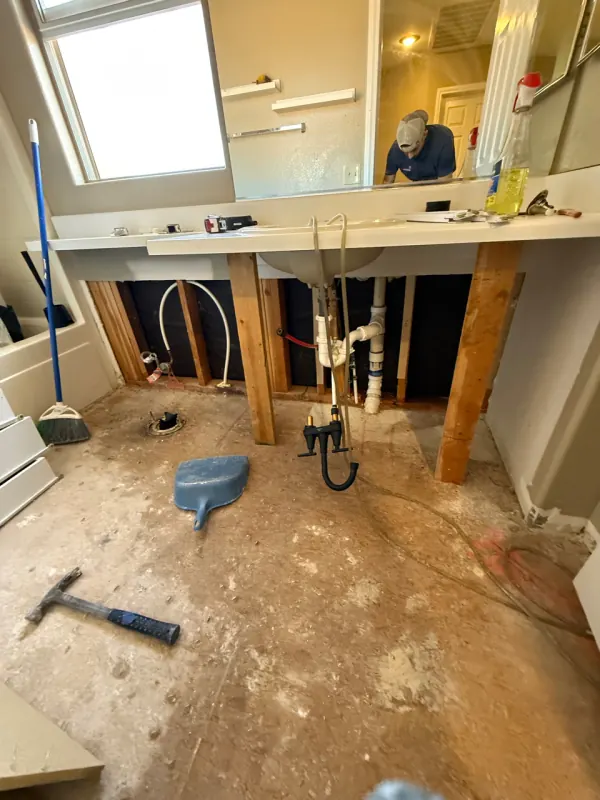
Most bathroom losses trace back to a handful of places, and they don't fail with equal odds.
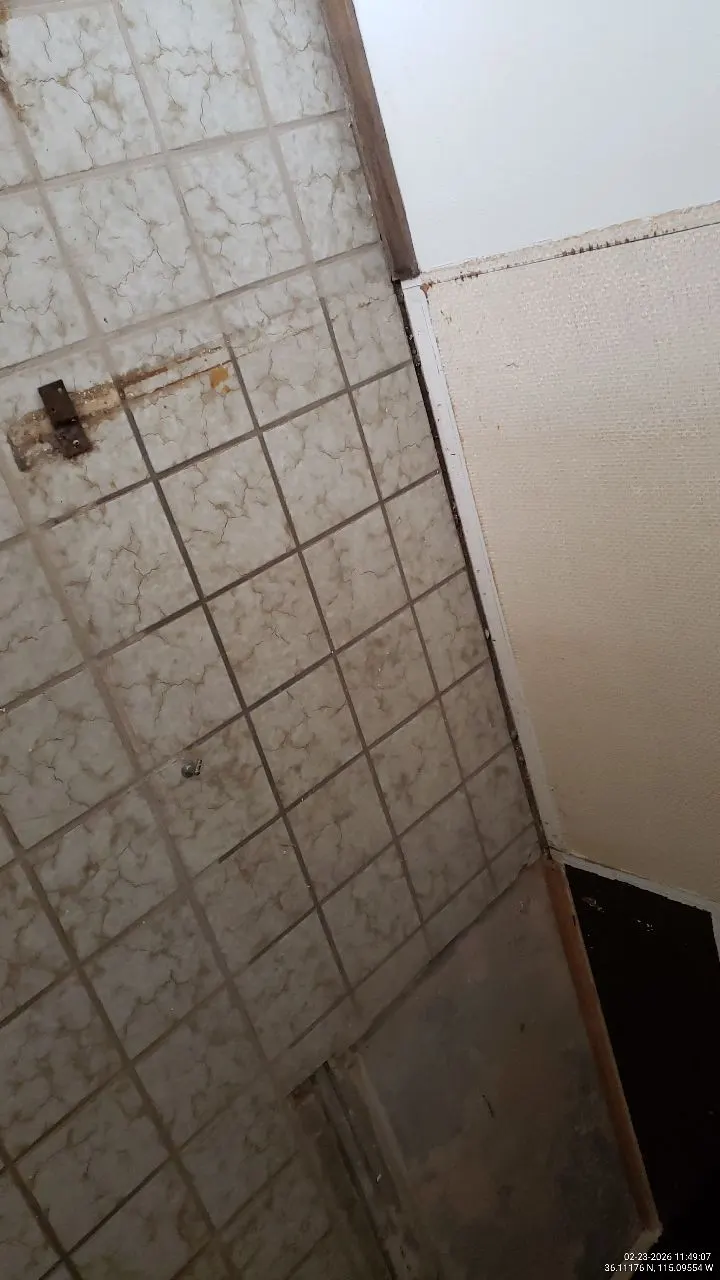
Toilet supply-side failures top that list for a reason. An industry study of toilet-related water losses found the average incident runs more than $5,500 after the deductible, and 78% of those failures came from a faulty supply line, a cracked flange, a bad fill valve, or a toilet that backed up and overflowed. If the water's tracking behind the tile rather than pooling on the floor, our water leak behind a shower wall page covers that path.
A different kind of leak
A toilet leak that looks clean often isn't. The wax ring's job is to keep what you flush moving down through the waste line, not out onto the floor. When it fails, water crosses onto the drain side before it ever reaches the floor, and industry water-category guidance is specific: water that has passed beyond the toilet trap is Category 3, grossly contaminated, regardless of how clear it looks. That's about where the water has been, not how it appears.
The classification decides the job. On a hard, non-porous surface — tile, sealed grout — a Category 3 event can sometimes be cleaned and disinfected in place. Once it's soaked into something porous (subfloor, drywall, baseboard), that material has to come out; there's no drying-in-place option for something you'll walk or sit on again.
It doesn't always stay on one floor, either. In a two-story home, a slow leak at the base of an upstairs toilet can travel through the subfloor and print a stain on the ceiling below, weeks later. Our ceiling water damage repair page picks up from there; if the water's already at raw-sewage scale, our sewage cleanup page covers the fuller scope.
Two different footprints
A blowout and a seep are the same problem with opposite footprints. A burst line puts water on the floor fast and spreads it outward (under the vanity, out the door, into the hallway), damage that's wide but often shallow, because there wasn't time to climb. A seep does the opposite. It's slow enough that nobody notices for a while, and in that time the water works its way up.
Drywall pulls water upward by capillary action at roughly an inch an hour, climbing as high as about 30 inches above where the water sat. That's why the cut goes well above the visible stain — a standard flood cut runs 12 to 24 inches above the waterline, because drywall that looks dry at the surface can still be wet a foot higher. Stop the cut at the stain and you've sealed wet material behind fresh paint.
The clock matters either way. The EPA notes mold can start on a damp material within 24 to 48 hours, so the gap between finding a leak and running drying equipment is the part of this job we control most directly. Our structural drying and drywall repair and replacement pages cover those two phases.
Who fixes what
And they belong to two different trades.
Moisture mapping, extraction and drying of what can be saved, removal of what can't, and the rebuild to a matched finish.
A leaking angle stop, a failed wax ring, a cracked supply line, a bad fill valve. We don't perform those repairs, but we'll tell you plainly what we're looking at, so you're calling a plumber for the right reason. See our plumbing page for how that coordination works.
Not sure which side of that line you're on? Call 888-453-3591 and describe what you're seeing. We'll tell you straight, including when the answer is that you need a plumber before you need us.
Call 888-453-3591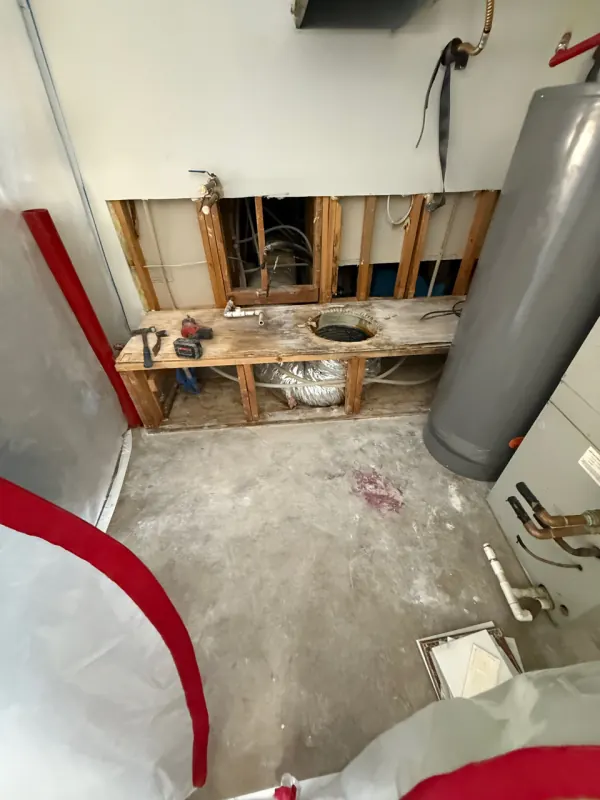
What the fix involves
888-453-3591 is staffed 24/7 — a failed angle stop doesn't check the clock before it lets go.
On site, we start by measuring, not tearing anything out. Moisture readings show how far the water traveled beyond what's visible: under the vanity, behind the tub surround, into the subfloor. That map, plus the water's category, decides what dries in place and what has to be removed.
From there it's extraction, drying until readings confirm the material is dry, and rebuild: subfloor, drywall, texture, paint, matched to the room. We document readings and photos in a form that supports whatever you file with your insurer; our insurance claim assistance page covers that side of it. Bathroom repair is one piece of our broader Water Damage Restoration in Henderson, NV work.
Quality 1st Restoration is based in Henderson and works throughout the Las Vegas Valley, day or night. A wet bathroom floor rarely stays small on its own — the water is already moving somewhere while you decide what to do about it. Call 888-453-3591. Someone answers, and we'll tell you honestly what we're looking at.
Call 888-453-3591Before you decide
If your situation does not fit neatly into one answer, call 888-453-3591 and describe what you see.
Depends how long it's been going and how far the water traveled, but this is the single biggest category of bathroom water loss: supply lines, flanges, and fill valves account for most toilet-related failures, and the average incident runs well over $5,500. A line caught the day it starts weeping is a much smaller job than one dripping into the subfloor for a month.
The classic signs: a toilet that rocks slightly when you sit or stand, water pooling around the base that isn't splash, a sewage-like smell, or (in a two-story home) a stain on the ceiling below the bathroom. Any one is worth a look.
It can be, and it's not about how the water looks. Once water has passed beyond the toilet's trap (which happens in most supply-side and overflow failures), it's classified Category 3, grossly contaminated, even if perfectly clear. That's why porous materials it touched typically get removed rather than dried and reused.
Depends on your policy and how your carrier classifies the event. Sudden, accidental losses are typically treated differently than a leak that went unaddressed a long time, and we can't promise what any carrier will decide. We document moisture readings, photos, and scope to support whatever claim you file.
No — repairing or replacing the failed fixture (angle stop, wax ring, supply line, fill valve) is plumbing work, outside our scope. We handle what the water damaged: drying, removal, rebuild. We coordinate around the plumber's timeline and tell you clearly when that call needs to happen.
Water Damage Restoration Service
Bathroom Water Damage Restoration is one part of our water damage restoration service work. If the damage is bigger than one task, start at the main category page and we'll scope the whole job.
Water Damage Restoration in Henderson, NVWhy trust us
For Bathroom Water Damage Restoration, trust comes from what gets verified on site: the source, the moisture, the affected materials, the cleanup scope, and the record that supports the job afterward.
A clean restoration job should leave you with a dry structure, a clear explanation of what was done, and documentation that makes sense weeks later if an adjuster asks a question.
IICRC-certified technicians follow accepted drying, cleaning, containment, and remediation procedures instead of deciding by appearance alone.
Photos, scope notes, equipment logs, and moisture readings are collected as the work moves so homeowners and adjusters can see what changed.
Crews test affected materials before and during the job, then adjust air movers, containment, and dehumidification to match the actual moisture load.
Emergency cleanup, controlled demolition, drying, cleaning, and build-back coordination stay under one restoration plan instead of being handed off blindly.
The team works across Henderson and the Las Vegas Valley, where slab leaks, appliance lines, roof leaks, AC condensate issues, and fast desert drying conditions are common.
What needs immediate attention, what can wait, and what should be handled by a licensed trade outside the restoration scope.
We avoid opening finished materials until moisture readings, contamination risk, and practical access have been checked.
Emergency response stays focused on stabilization first, then drying, cleaning, and repair decisions after the building is under control.
From slab leaks and burst pipes to monsoon water and roof leaks, every water loss starts differently. We identify the source, remove standing water, dry affected materials, and plan the cleanup around the property.
Request emergency water cleanupCall Quality 1st. We answer 24/7 and help with water removal, drying, cleanup, repairs, and insurance paperwork.