Certified standards
IICRC-certified technicians follow accepted drying, cleaning, containment, and remediation procedures instead of deciding by appearance alone.
A leak in a condo rarely stays inside the walls it started in. Water that begins in a unit two floors up can be a stain on your ceiling by Thursday, and fixing it touches everyone in between — you, the owner upstairs, the property manager or association, and sometimes an insurer on each side of that chain.
Quality 1st Restoration handles the physical damage and the documentation your neighbor, your association, and your own carrier will each ask for. Call 888-453-3591: whether the leak started upstairs or in your own unit, someone picks up nights, weekends, and holidays, not just business hours.
The upstairs pattern
Most Las Vegas Valley condo owners could sketch this pattern from memory. A stain shows up on the ceiling. You knock on the door upstairs, and the neighbor is apologetic, sometimes even offers to cover it outright. Then estimates come in, and the offer gets quieter. An adjuster or the association steps into it, and a hallway promise turns into a process with paperwork of its own. It isn't universal, but it happens often enough that we treat it as the norm, not the exception.
None of that changes what helps right now. Get the water stopped — yours or theirs, whichever valve it is. Photograph the ceiling, the stain's edges, and anything underneath it before you touch it. Put your association on notice in writing, even if you've already called or texted someone; a paper trail is worth more later than it costs to write now. Whatever the association or either carrier eventually decides, confirm it directly with them, not from what got said in the hallway. If the water is coming down through your ceiling rather than up through your floor, our ceiling water damage repair page covers that half of the job in more detail.
Coverage basics
Which policy actually pays? Two policies usually sit behind a condo water loss, and they cover different things. The association carries a master property policy on the building; the unit owner typically carries an HO-6 policy. The Nevada Division of Insurance describes the HO-6 as covering "a unit-owner who insures his/her property...to cover any items not insured by the association's policy," including personal belongings and the wall, floor, and ceiling finishes inside the unit. The NAIC describes the same form nationally: it "insures your personal property and your walls, floors and ceilings."
Nevada law adds a wrinkle specific to attached buildings. Under NRS 116.3113(2), an association's property insurance in a building with units divided by shared floors or walls generally must include the units themselves, "to the extent reasonably available," though it doesn't have to cover improvements or betterments an owner installed. Under NRS 116.31133, the association's policy is primary over an individual owner's policy when both apply, and the association's insurer waives its right to pursue a unit owner for the loss.
None of that tells you what your specific loss will cost you or who pays which deductible: that depends on your association's governing documents and the actual policy language, not a statewide rule.
This is general information, not legal or insurance advice.
Confirm coverage, deductibles, and next steps with your carrier and your association.
Shared assemblies
A condo unit isn't a sealed box. Water that lands in one unit moves through shared plumbing chases, common framing, and interlocking floor assemblies before it stops. That's why damage often shows up somewhere other than where the leak happened. Chasing that path sometimes means we need access to a neighboring unit that never got wet on the surface, and getting that access usually runs through whoever manages the building, not just the two units involved.
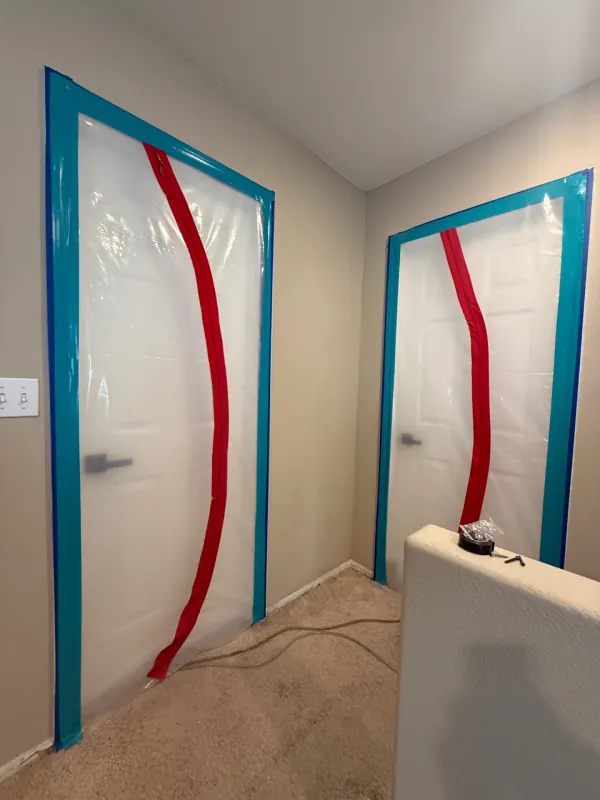
Drying has to keep pace with where the water actually went. If a shared wall or floor cavity is wet on both sides, we run equipment in both units at once. Why both sides? Because reconstruction can't start on one side while the other is still drying — the moisture just migrates back. Throughout, we follow ANSI/IICRC S500 (the standard the restoration industry works from) for assessment, drying, and documentation, and every reading gets logged so it can go to more than one insurer if more than one policy is involved. Our structural drying and moisture mapping pages cover how that equipment and measurement work in more depth.
If the unit needs to clear out
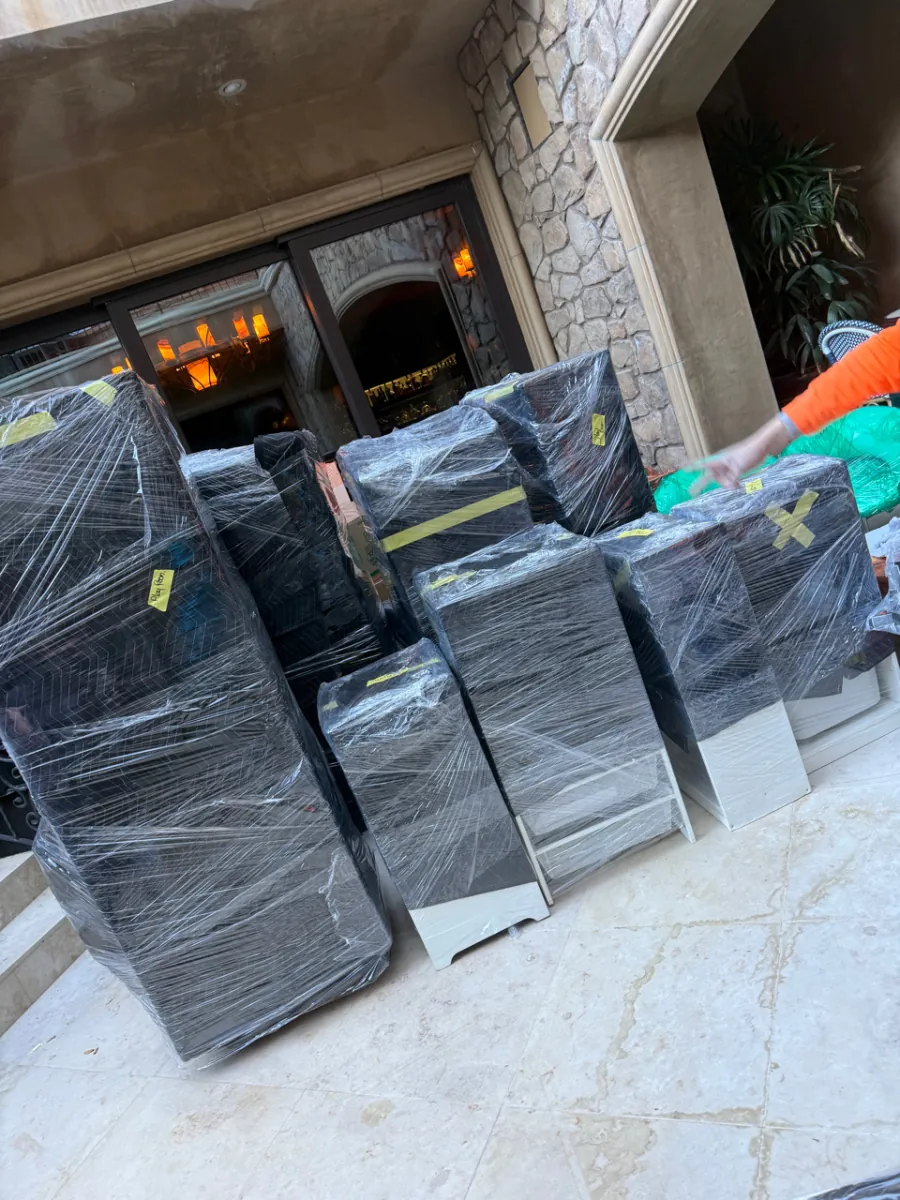
Can you stay in the unit while it dries? Sometimes. Some condo losses are survivable with the water shut off and drying equipment running around you. Others aren't — a saturated ceiling over a bedroom, or a unit that needs equipment running in every room, isn't something you live alongside for a week.
When a unit needs to be cleared out, we pack contents at the box level, with each item inventoried before it leaves (furniture, electronics, whatever was in the closets and cabinets), so what comes back matches what went out. Our contents pack-out and restoration service covers that piece end to end.
The scale of it
Clark County counted 78,273 condominium units in its 2023 housing estimate — 19,722 of them in the City of Las Vegas, 8,078 in Henderson, and another 15,050 in Paradise alone. That's a lot of shared walls, shared risers, and shared roofs across the valley. A leak in any one of them can involve more than one unit before it's over.
This page is written for the individual owner dealing with a leak in their own condo. If you're a property manager or an association handling water damage across an entire building (common areas, multiple units, or a structure-wide claim), our commercial water damage restoration service covers that scope instead. For everything else we handle beyond condos, see our Water Damage Restoration in Henderson, NV hub.
Quality 1st Restoration is based in Henderson and works the full Las Vegas Valley — high-rises near the Strip, garden-style communities in Spring Valley and Enterprise, and everything built up in between. A condo leak involves more people than a single-family leak does. We handle the drying, the removal, the rebuild, and the paperwork trail each of those people will ask for. Call 888-453-3591, nights, weekends, holidays, any day of the year.
Call 888-453-3591Before you decide
If your situation does not fit neatly into one answer, call 888-453-3591 and describe what you see.
It depends on more than whose fault it was. It depends on where the water crossed a boundary Nevada law treats differently (common elements versus a unit's own systems), what your association's master policy form actually covers, and what your own HO-6 policy backs up. We don't make that determination; your carrier, your association, and the policy language do. Document everything, and confirm coverage with your carrier and your association before assuming who's responsible.
That's a decision for you and your insurance agent, not something we can advise on. What we can tell you is what tends to happen in practice: each damaged owner often ends up filing with their own HO-6 carrier while the association pulls the master policy in for anything involving common elements or original construction. Confirm the right approach for your situation with your carrier and your association.
Sometimes, partly. Nevada law generally requires an association's property insurance in a shared-wall or shared-floor building to include the units themselves, "to the extent reasonably available," though it doesn't have to cover improvements an owner added. Some master policies stop at the bare structure; others go further. Which kind your building has is in your CC&Rs and your policy declarations, not something a statute settles by itself. Confirm your specific coverage with your carrier and your association.
The same way we'd dry any wet assembly, just on both sides of it. We map the moisture on both sides, run equipment in each affected unit at the same time, and keep drying until both sides read dry. Rebuilding before that point just traps moisture in the assembly instead of solving it. Getting into the neighboring unit for that work usually means coordinating access through your property manager or association.
It happens, particularly when common elements or the building's original construction are involved rather than just the contents inside one unit. If that happens on your loss, we keep working the physical restoration and documenting it the same way regardless of which party is coordinating the claim. Confirm who's handling what with your association and your own carrier so nothing falls through the gap between the two.
Water Damage Restoration Service
Condo Water Damage Restoration is one part of our water damage restoration service work. If the damage is bigger than one task, start at the main category page and we'll scope the whole job.
Water Damage Restoration in Henderson, NVWhy trust us
For Condo Water Damage Restoration, trust comes from what gets verified on site: the source, the moisture, the affected materials, the cleanup scope, and the record that supports the job afterward.
A clean restoration job should leave you with a dry structure, a clear explanation of what was done, and documentation that makes sense weeks later if an adjuster asks a question.
IICRC-certified technicians follow accepted drying, cleaning, containment, and remediation procedures instead of deciding by appearance alone.
Photos, scope notes, equipment logs, and moisture readings are collected as the work moves so homeowners and adjusters can see what changed.
Crews test affected materials before and during the job, then adjust air movers, containment, and dehumidification to match the actual moisture load.
Emergency cleanup, controlled demolition, drying, cleaning, and build-back coordination stay under one restoration plan instead of being handed off blindly.
The team works across Henderson and the Las Vegas Valley, where slab leaks, appliance lines, roof leaks, AC condensate issues, and fast desert drying conditions are common.
What needs immediate attention, what can wait, and what should be handled by a licensed trade outside the restoration scope.
We avoid opening finished materials until moisture readings, contamination risk, and practical access have been checked.
Emergency response stays focused on stabilization first, then drying, cleaning, and repair decisions after the building is under control.
From slab leaks and burst pipes to monsoon water and roof leaks, every water loss starts differently. We identify the source, remove standing water, dry affected materials, and plan the cleanup around the property.
Request emergency water cleanupCall Quality 1st. We answer 24/7 and help with water removal, drying, cleanup, repairs, and insurance paperwork.